
Overview:
After Tomb Raider: the Angel Of Darkness had been considered a failure. Core Design (Core), in 2004 came up with a new Tomb Raider Project. The project known as “Tomb Raider: 10th Anniversary Edition” aimed to recreate the original Tomb Raider game released in 1996 including various enhancements and extensions to the original game. Core developed their version of Tomb Raider: 10th Anniversary Edition for approximately 9 months until it was cancelled early June 2006 by SCi. A trailer for the unfinished game emerged on the internet, later that week Eidos officially confirmed the game had been cancelled. Following these events, Crystal Dynamics developed their own Tomb Raider: Anniversary game which released in 2007.
Origin:
Interview by: PlanetLara with former Artist Richard Morton. (24th July 2007)
Richard: It was a strange time really, we’d just finished Free Running for PSP/PS2 and had developed a really good control system and camera, we started messing about with a Lara model on the PSP in the Free Running engine and the idea of 10th Anniversary was born. We suggested it to Eidos who allowed us to develop it, but when Core was sold to Rebellion it seemed like they didn’t want the franchise to go ‘out-of-house’ hence the cancellation of our project.
It is confirmed that PC/PS2 versions were also in development. However, the existing leaked footage and in-game screenshots have been confirmed to be taken from the PSP version. The trailer which leaked from an unknown source seems to show various different builds of Tomb Raider: 10th Anniversary Edition. Some sequences in the trailer are from builds later than others. Both Core Design and Crystal Dynamics were working on separate games (Core Design – Tomb Raider: 10th Anniversary Edition, Crystal – Tomb Raider Legend). Eidos (the game’s publisher at the time now Square Enix) requested Core Design to alter their Lara Croft model so it looks similar to the Lara Croft model used in Tomb Raider: Legend. This is why the Lara Croft model seen in early prototype versions of Tomb Raider Legend is very reminiscent of the one seen in Core Design’s Tomb Raider: 10th Anniversary Edition.
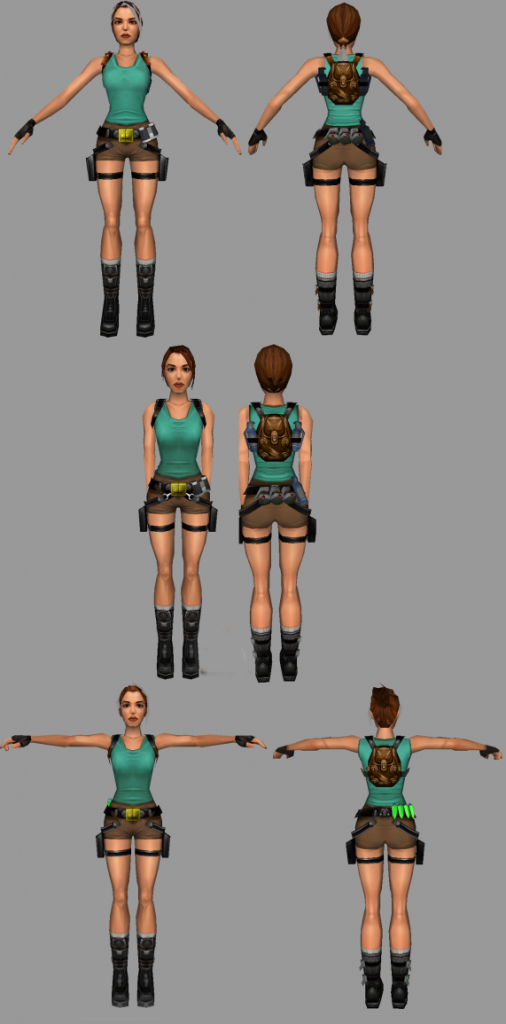
Various variants of the Lara Croft model and how it changed during development
The leaked trailer:
Press releases:
By Core Design (www.core-design.com) – 15th June 2006, 11:02:06.
Following speculation on the internet, we would like to offer the following clarification.
The video of Tomb Raider: 10th Anniversary Edition that appeared on certain sites was an unauthorised release of an internal presentation of a game that was being developed by Core Design until very recently. It was running on PSP and used a Core-developed engine. However, following a recent review this project has been officially cancelled by SCi.
Core is alive and well and working on some great new projects, and we are still planning to announce some exciting news very soon!
By Former Core Dsign Arist Carl released a fly through video of a level he worked on:
By Eidos – June 16th, 2006
Eidos Interactive, one of the world’s leading publishers and developers of entertainment software, confirms today that they are developing a special ’10th Anniversary Edition’ of Tomb Raider.
The new game is being developed by Crystal Dynamics, who recently launched Lara Croft Tomb Raider: Legend on Xbox 360, PS2, Xbox, PC and PSP, with versions on Nintendo DS, GBA and GameCube later in 2006.
“Our ’10th Anniversary Edition’ of Tomb Raider, is a one-off title to celebrate both Lara and Tomb Raider, it will appeal not only to the loyal fans of the Tomb Raider series but will also attract a totally new audience.” Said Larry Sparks, Head of Brands Management at Eidos.
Tomb Raider originally launched in 1996 and is still one of the best selling videogame franchises of all time, with over 30 million copies sold.
The special ’10th Anniversary Edition’ of Tomb Raider will be available on PlayStation 2, PSP and PC.
Core Design’s opinion:
In 2016 an interview with Gavin Rummery was published by arstechnia. It provided some details as to how the game started and speculation as to why it was cancelled:
By: Gavin Rummery (Former Core Design Studio Head) – 31/03/2016 arstechnia
He put the pieces together in his head and pitched Eidos/SCi (SCi having taken over Eidos in 2005). They loved it, so a team of Tomb Raider veterans at Core set about remaking the original game in the new engine. It was going well, Rummery recalls—both looking and playing great. But Crystal Dynamics didn’t want Core back in the picture, and the American studio built a rival demo.
“They convinced whatever the politics in SCi was like that it made more sense to just keep it all in one studio,” says Rummery. “Keep the franchise in one place. And so ours was killed, and you’d have never heard if it hadn’t been leaked by someone.”
Steve Pritchard responded to Gavin’s claims with the following:
Steve Pritchard (Producer) via Facebook
No worries. It was a tricky time in the studio when Crystal were doing Anniversary – a lot of hard work had gone into that idea and to have it taken away and handed to Crystal was a painful thing.
Crystal Dynamics are in no way at fault for this – Eidos had become SCi at this point and that whole Eidos/Core/Tomb raider multi-brand was something that hung a little heavily around a few necks. Someone, somewhere, realised that handing a TR title back to the now-not-Core guys would have seemed like a strange commercial move, and with CD having a lot of cool tech all ready to go, it was a straightforward choice for them.
Yeah, it was a massive, massive kick in the nuts for those of us who had done a lot in a very short space of time to get Anniversary running, but from a business perspective it was understandable.
Gav was right to be angry about the way the whole thing unfolded and he’s also right in saying that SCi were up for it – Ian Livingston grinned a smile a mile wide when I described the concept as a “director’s remastering” of the original, with additional content filling out the whole TR1 game. So yes, it was a winner and yes, at the time it looked like me might claw it back. But someone, somewhere realised the media issues that might arise from the old Core lads doing another Lara game . . . and that was where the split began, not with CD.
I put more hours into the Core version of Anniversary than anyone else on the team – production tend to do that – and as we had such a small team most of what is seen in the leaked video was stuff I pulled together across a couple of evening shifts, the thing cut together by Gaz Tongue later. We were all gutted when the project went away. Projects do, all the time, but this one really felt like the last chance to grab back a bit of TR.
The last presentation to the SCi board had Gav and I demoing the Playstation version AND the PSP version, both of which had co-op gameplay in it. They were rough around the edges, still some way from alpha, but if you knew the original game well you could see where we had added real fan service, extra content and just cool stuff that expanded on the original narrative. It felt good to show off, it was received well, but that last presentation had us re-introduced to Toby Gard and some of the CD team who were there to see it. Two days later we got the news that they were going to do the Anniversary project, using their engine and tech from TR Legend. And that was that.
Horrible end to the story but I find it really difficult to lay the blame at Crystal’s door. SCi made the decision, and they really weren’t very good at decisions. They are not there for good reasons.
Not too long after that the studio was sold to Rebellion, Gav moved on and I ended up running the show for the next 18 months to two years. By then Core were a bit battered and bruised and being asked to shift their skills to “quick and dirty” work that was almost outsourcing saw all the talent start to pour away to other companies. “Corebellion” fought on for a while but the writing was on the all by then.
Images: