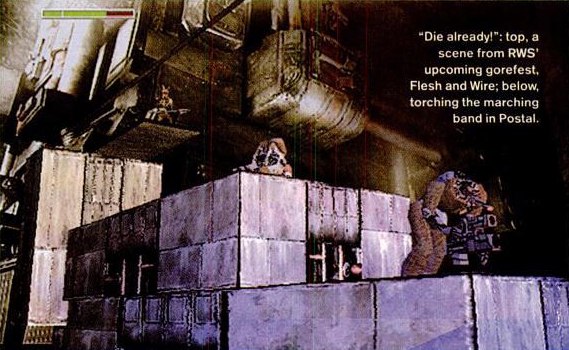
Flesh & Wire is a cancelled action adventure that was in development by Running With Scissors (of Postal fame), announced in 1999 and planned to be published by Ripcord Games for Playstation 2, Dreamcast and GameCube. It would have been and over-the-top shooter where you could control an alien blob to explore the world and resolve environmental puzzles. As we can read on IGN:
“The game follows Angus, a sleazy, slimy cop who wakes up one morning with an alien amoebae-like creature noshing on his legs, and his city has been engulfed by a bio-ship by the name of the Nulloid. Rather than worry about what the heck the thing’s doing to his lower half, he comes to the realization that he can control the gelatinous blob, and uses this newfound power to move around and utilize special abilities, sloshing around the levels. He’ll also utilize massive amounts of firepower, so expect over-the-top violence […]”
In 2016 Running With Scissors CEO Vince Desi talked about Flesh and Wire in an interview posted on their official website:
Robin TGG: I had almost forgotten that you once worked on a title called “Flesh and Wire”. What was that game all about? And why was it canceled?
Vince RWS: Yeah that was after POSTAL got cancelled, we actually had 2 other original games in development, but financial reality simply didn’t allow us to continue. It was a sci-fi based game that had a blob as the main character, I really liked it, who knows maybe someday we’ll take another look at it.
The game was somehow similar in concept to a more violent “A Boy and His Blob”, as you could transform the blob into different forms, such as a ladder to reach high places, a bungee to get down and a shield to protect the protagonist from bullets. Some more details on its development can be read on the March 1999 issue of Game Developer magazine:
“According to Randy Briley, the soft-spoken art lead for the project, the development process for FLESH & WIRE (FW) has always been a little bit different. For starters, the publisher (Ripcord Games) has been very hands-off, letting the development team drive the development. This uncharacteristic display of trust has as much to do with RWS’s track record of getting products out the door on time as it does with Ripcord Games’ relative newness to the gaming scene. And although the style of game play has some basis in currently released titles (the game is some-thing of a cross between RESIDENT EVIL and THE THUNDERCATS), the look of the game is anything but conventional. From character design and animation to background generation, the unorthodox look derives from equally unorthodox production methods.
When RWS finally settled on the game spec, they realized that from a resource production standpoint, they had bitten off more than they could chew. In addition to the standard budget of special effects, GUI art, and several minutes of cut scenes, the spec called for over 200 static screens of game play with in betweens, and a set of enemy and player characters’ 300+unique animation sequences. With a production cycle of just under 18 months, no budget for outsourcing, and an extremely small art team, the task seemed pretty daunting. It was time to improvise.”
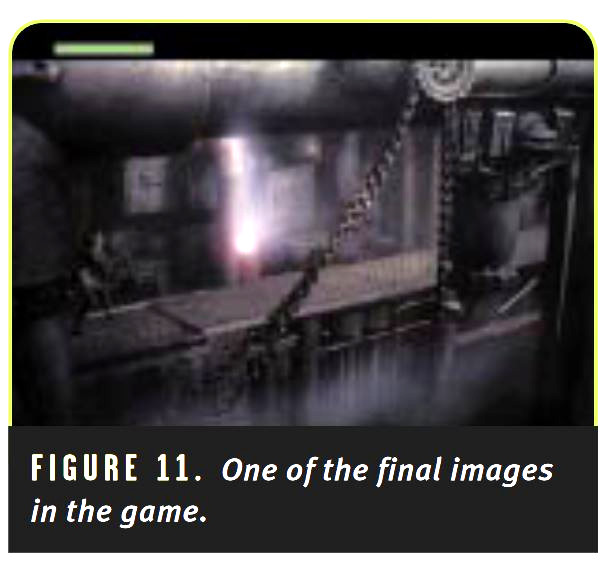
[…] rotoscoping could be done largely in-house with little or no overhead, the production time compared to hand animation was much faster, and although it required the talents of a skilled animator to implement, it provided a cheap, efficient method to complete the animations on schedule. The team went down to a local gymnasium and interviewed several martial arts students. Then, working closely with the art lead (a martial arts expert himself), the actors were mocked up to look like the characters in the game. Several sets of motion shots were taken, using two synchronized digital cameras set 90 degrees apart (front and side). After digitizing these images and importing them into Softimage, the result was a sequence of images. The Animator then animated the characters by hand, using the images as a guide. […]
Compared to the mammoth task of generating over 200 hundred in-game background scenes, the character animation problem looked simple. With only a handful of 3D artists on staff, the team had to make some tough decisions. As the project evolved through its initial stages, it became clear that the art direction was evolving towards the techno-grunge look typified by such industry standards as The Crow and City of Lost Children. The level of detail the team wanted would require hours of tedious texture and modeling work using classical CG methods. Given the size of the team and the allotted time, this simply would not be possible. Rather than cut the design or ask for more time, the team resolved to find a solution that would allow them to maintain the scope of the project while holding true to the artistic vision. They Took a gamble, and decided to build the entire game using miniatures.
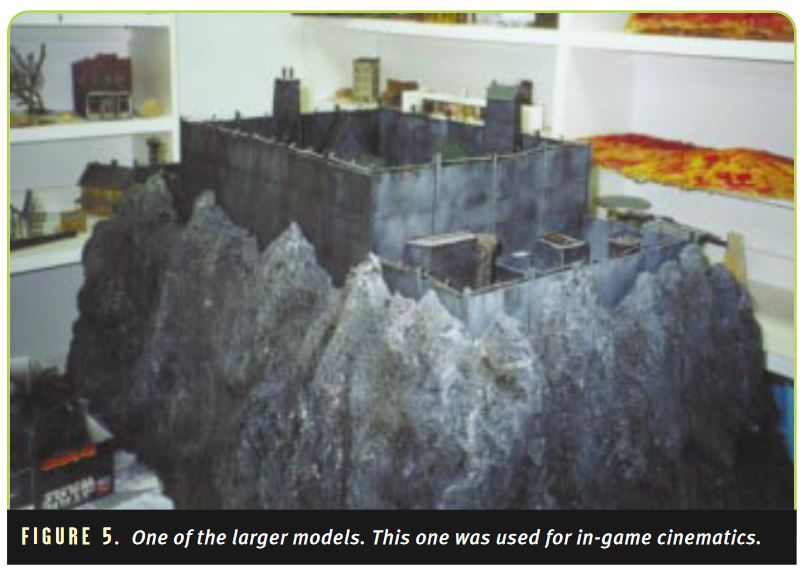
“Near the end of the planning phase of the project, RWS presented the publisher with a proof of concept for the process. For the first test, the team put together a town from a model railroad set and digitized it into the POSTAL engine. In short, the result was a huge success.
Put simply, the sets for the game were built with “anything we could get our hands on,” says RandyBriley. Basically, the team would just bring stuff in: PVC piping, copper tubing, old VCR’s, and so on, and the pieces were glued together and painted using a hot glue gun and standard modeling paints. Most of the back-drops for the game were created using Styrofoam panels, which proved easy to get hold of and standardize. “Once we got an assembly line going with a certain panel (background piece), we could crank each one out in a matter of a few hours.”
By far however, the biggest advantage of the process is the lack of any requirement for CG expertise on the part of the artists. Consider that with a single trained 3D artist to guide the process, the bulk of the artists can be classically trained with little or no industry expertise. This means that production costs go down for any given piece of work or, you get a lot more resources for a lot less money.”
As said by Vince, in the end they were not able to keep up development for 3 different projects at the same time, so Flesh & Wire had to be canned. We hope someday to be able to see some more images from this strange and original video game.
Thanks to Josef for the contribution!
Images: