
Nintendo

Golden Sun [GBA – Beta / Unused Weapon / Debug]

Golden Sun is the first installment of a series of RPG games developed by Camelot Software Planning and published by Nintendo. It was released in November 2001 for the GBA, with a sequel, Golden Sun: The Lost Age, in 2003.

Golden Sun underwent a development cycle of between twelve and eighteen months by Camelot, which is considered quite a long period of time for the development of a handheld video game, and was described as a “testament” to the positive results a long development cycle can bring to a game. It was shown in early, playable form at the Nintendo Spaceworld Expo in Japan on August 2000. North American previewers received the game a few weeks before the release, and IGN noted that the experience of developing Shining Force for Sega helped Camelot develop a gripping RPG for the handheld.

Originally, Camelot planned to create a single title instead of a series, and in the extremely early stages of their project they had created a game design document for the one Golden Sun game to be on the Nintendo 64 console. When it became apparent the N64 was on its way out because the Nintendo Gamecube was coming in, Camelot shifted their focus to making a game on the handheld Game Boy Advance. [Info from Wikipedia]

In these old screens we can see a beta version of Golden Sun, with differences in the graphic style, in the characters design and in some weird places. The Kusanagi is a Light Blade that is found in the Debug Menu of the original Golden Sun. This weapon is impossible to access during normal play and can only be seen using a hacking device. Ironically, this weapon’s graphic is officially used in Golden Sun: The Lost Age for the Light Blade artifact Masamune. If it had been in the original game it would have been the most powerful Light Blade surpassing even the Kikuichimonji. You can find more info at The Adepts of Weyard website and at GoldenSun Wikia!

Thanks to Robert Seddon for these links!

Images:

 

Fire Emblem 6: Fuuin no Tsurugi [Beta – GBA]

Fire Emblem: Fuuin no Tsurugi (The Sealed Sword) early beta screens from the game show different characters and graphic style. Different HUD and graphics are present, as well as Roy’s very different portrait. The weapon and item icons seem to be placeholders, as they’re all what look to be Iron Swords, but their names are different.

Thanks to Iven Allen for the contribution!

Images:

Videos:
 

Super Mario Kart [Beta – SNES]

At the Digital Press Forum, van_halen has posted some photos from a prototype version of Super Mario Kart, a “beta” with some interesting differences, like early version of some of the sprites, different layout and music in some levels, different title screen, select screen and “choose-your-driver” screen, missing “black X” from the Lakitu’s flag (when you drive in the opposite direction), a flying Super Koopa and missing reward cups in the ending scene. Check the original topic for more infos. Huge props to van_halen for sharing these images!

In an old magazine, MathUser has even found a couple of screens that show a different design for one of the tracks, maybe an early version of the Mushroom Cup Round 2, as Madou has wrote in the HPZ Forum

In an episode of Iwata Asks, we can read that:

Konno: Originally, the development of Super Mario Kart began with the idea of creating a two-player racing game in contrast to the single-person gameplay of F-Zero.

Miyamoto: Just so there’s no confusion, however, I should point out that we didn’t set out to create a two-player version of F-Zero. We set out to make a game where we could display the game screen for two players at the same time.

Konno: With more than one player, it would have been impossible to illustrate the high speeds of F-Zero.

Iwata: Why did you decide on using Mario?

Konno: Well, in the very first prototype, there was a guy in overalls sitting in the kart.

Iwata: Wait just a minute! I can’t let that slip by. Did you just say a guy in overalls?

Konno: Sounds like Mario, doesn’t it? It wasn’t like I forgot to put Mario’s beard on him or something, though… (laughs)

Miyamoto: For F-Zero the characters were seven heads tall, but for Super Mario Kart, we decided on three heads tall characters in order to suit the design of the karts.

Iwata: How long was it before Mario himself actually appeared in the karts?

Konno: It was about three to four months after we started development, when we had created a prototype involving two karts racing simultaneously.

Miyamoto: At first, no racing was involved. It was just two karts moving around freely. Then we noticed that it looked neat if you stopped one car and looked at the other car flying by. We decided to see what it would look like with Mario in one of the karts, and everyone thought that looked even better. Who knows, maybe the designer who drew the overalls on the earlier guy intended that it be changed to Mario all along! (laughs)

Konno: Back then, instead of a banana peel as an item, there were little oil cans. If you threw one out, the oil would spill, sending the karts spinning.

Iwata: How did you come to make the race and battle modes?

Konno: We had decided from the start that there would be races, but we thought that it would be good if the game served as a communication tool in which one-on-one battles were possible via some other kind of gameplay rather than simply competing for rank, and someone had the idea of popping each other’s balloons.

Thanks to Youloute for the contribution!

Images:

Videos:


Donkey Kong Country [SNES – Beta / Concept / Unused Stuff]

Donkey Kong Country is one of the most famous Rareware games made in Super Nintendo. The technology of Advanced Computer Modeling helped Donkey Kong Country makes a successful fame and great looking graphics.

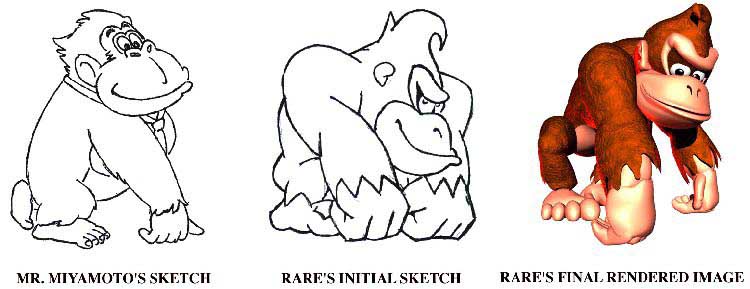
But not giving much words, the old chimp, Donkey Kong, have been changed during the development. Shigeru Miyamoto first idea was to make Donkey Kong looks like the Donkey Kong Jr., from the NES, the RAREware employers decided to make Donkey Kong looks more strong and looking more “cartoonish” . The Final rendered image have changed, such as, less beefy and with a little less hair. Check the image below:
~You can click the image below to enlarge it~

Also, Robert Seddon has made us notice about a series of Donkey Kong Country unused stuff that some lovely geeks at DKC Atlas have found out in the memory of the game, like unused rooms and sprites. You can read the full topics in here, here and here. Thanks a lot to Robert for these links and  props to the DKC Atlas guys for the finds!

Thanks to Lucas and Gabrielwoj for the contribution!

Images:

Videos:

In the Video above, it’s possible to notice some differences:

-The Banana Counter was no limit, it would be possible a “collect all bananas” mode that was scrapped?;
-Banana Animations are a Little more faster;
-In Funky Flights, Donkey Kong and Diddy Kong don’t jump too high in Final version;
-At 4:00 , there is a Concept Art with both Kongs using the Team-Up move, these was used later in Donkey Kong Country 2 and Donkey Kong Country 3;
-At 7:35 , when Donkey Kong in running with the Steel Keg, the checkpoint doesn’t activate. It was fixed in Final Version;
-At 8:07 , when the player gets s Life (Balloon), the sound effect is really different than the final version;
-At 9:00 , it’s possible to see a Debug Coding at the corner of the screen;
-At 12:03 , the First Level is Raining. Even if the player (in final version), does reach at the end and go back, this doesn’t happens;
-Some of the animations are a little more slow, and some others are too fast.