Game Boy Advance (GBA)

Blue Angelo [GBA – Cancelled]

Created by Adriano Baglio (Virtual Spaghetti) and published by Shibuya Interactive, Blue Angelo was originally developed in 2004 for the Korean GamePark 32 console and well received by the public. Little information is available on Shibuya Interactive but the company appears to be no longer in existence. Unfortunately the GP32 sold poorly and prevented the game from gaining any real attention. While a Game Boy Advance version of Blue Angelo was planned for release after the European launch of the GP32, the Korean handheld was never released there and thus the Game Boy Advanced port was canceled.

Firmly embedded in sci-fi and fantasy, Blue Angelo’s storyline involves the idea that Earth is a planet created by a group of unknown creatures. While Earth is instinctively violent, humans have progressed to the point where a large number of the population has left the planet in order to pursue colonization in other parts of the galaxy. One of these planets, Lyra, has been afflicted by a variety of monsters and demons. The scientists on Lyra create a fighter of their own (controlled by the player) in an effort to eliminate any existing threats on the planet. Mysterious in nature, the fighter does not eat or drink and has a lifespan limited to the course of only one year. This creature is called “creature 331” or Blue Angelo. The subtitle of the game appears to have been “Angels from the Shrine,” but it remains uncertain exactly how this subtitle factors into the Blue Angelo storyline.
blue-angelo-gba-cancelled

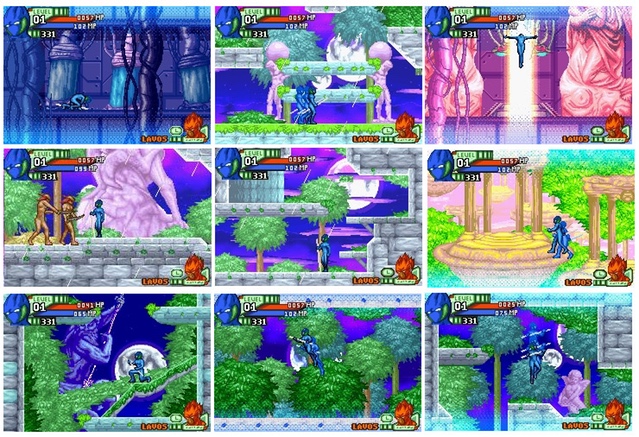
Blue Angelo for the Game Boy Advance was about eighty percent completed on Livello, a level editing program, before it was canceled. There are currently two playable versions of the of the GBA version available online: one offers only a demonstration of two monsters, while the second version is a more polished prototype. These small samples of the game are merely intended to provide an idea of the work in progress and show off gameplay elements. The GBA version of Blue Angelo utilized parallax scrolling of 4 or 5 layers while adding transparency special effects, which at the time was unprecedented for handheld consoles. It is unknown if the GP32 version used the same method.

The sidescrolling mechanics and button use for Blue Angelo appears to be fairly standard with the exception that the L button of the GBA port is designated as the “call the invocation lavos” button (according to available information on the game). While not exactly explained, this does sound like a summons button and would fit with the game’s world.

For many years, a reboot of Blue Angelo was considered. A failed Kickstarter campaign was launched for a PC version of an updated Blue Angelo game, emphasizing a complete redo of the game with improved graphics and providing each character with a unique feature. The game’s designers wanted to use the Unity Engine 2D to achieve organic 2D effects that are both easy to understand and simple to navigate. New stories and a unique universe apart from the GP32 and GBA versions of the game were also created for this renovation. It’s unknown how much of the story would carry over from the original game.

This Kickstarter was run by the publisher Vetasoft, a company founded in 2009 by the brothers Adriano and Massimia Baglio in Mons, Belgium. Vetasoft has established a reputation as a game developer for mobile devices, developing such games as Lucky Luke Shoot & Hit, Yakari Wild Ride, and Garfield’s Wild Ride. While the Kickstarter failed to reach its goal, it’s unknown if Vetasoft will continue pursuing the Blue Angelo reboot.

Article by Blake Lynch, thanks to Lanz for the contribution!

Images:

Videos:
 

Chronicles of Eden Vol I: Vangarde’s Tale [GBA – Cancelled]

Long title, short story. Chronicles of Eden Vol.I: Vangarde’s Tale was announced in 2004 by its developer Lightspire Studios as an upcoming Gameboy Advance title. The game was supposed to be a top down story driven action adventure/ role playing game. At the time of announcing the game no publisher was known yet and nor was a hint given on a final release date.

The game tells the story of Dyrvaine, an elite agent of the Elven Council of Tannale. The agent is sent out to investigate mysterious activities with a gate seal on a world called Elzian. The game was divided into four episodes and would give the player three characters to choose from, each wit an unique style of gameplay and each one with a different look on the storyline. A fourth character would become available after completing two of the four episodes. An interview with one of the makers of the game by Planet Gameboy can be read here.

After the announcement things became quiet on the game and it is assumed to be fully cancelled, most likely too hard to find a publisher for the game.

Promotional video:

Screenshots:

Extra – Artwork, possible Box Cover & Lightsphere logo:

(note: I only picked 3 recognizable pictures shown in the promotional video.  more?) 

Aegis: The Awakening (Sennari Interactive) [GBA – cancelled]

413005-aegis_010

Aegis: The Awakening was a fantasy action adventure for the GameBoy Advance and was announced early in 2002 by its developer Sennari Interactive, the same company that was responsible for GBA ports of games like Powerpuff Girls and Driver 2. Aegis: The Awakening was mentioned on Sennari’s website under GBA titles and was marked as “concept developed”; only a brief description for the game was given:

“The city of Aldara is besieged by an unknown enemy with powerful allies who hope to gain the secrets of magic that certain residents of the city hold. The player must take the role of guardian of the city, one who has unfathomable powers that have lain dormant over the centuries. Seek out the individuals that the enemy wants in order to gain powers and abilities that these people can awaken within you. Seek them out to defend the city and learn your heritage, to learn that you are a member of the legendary protectors of the earth, the Aegis.”

The concept development status of the game stayed unchanged until the end of 2003; I could retrieve no valid reasons why Aegis was cancelled besides their change of focus towards the cell phone market. There is little to none information on the game to be found besides the old Sennari announcement made in 2002 and an article on Gamespot in which the game is mentioned (see part of the article below). Date of cancellation? My guess is late 2003.

Sennari 2002 line-up – Gamespot – February 2002:

IGN 2002 - Sinnari Lineup

Images: 

Dune: Ornithopter Assault [GBA – Cancelled]

Frank Herbert’s Dune: Ornithopter Assault is a cancelled flying / shooter game made by Soft Brigade that was going to be published on the Gameboy Advance by Cryo Interactive. Development of the game started in 2001, but in summer 2002 the project was shelved, even if it was basically finished (all the missions are completable), before submission to Nintendo due to Cryo’s financial difficulties.

This is the game’s fact-sheet published at the time in the official website, now offline:

Trained by Gurney Alleck, the most efficient and honoured officer of the House of Atreides, you are going to become a specialist in piloting and fighting ornithopters. Involved in all-out war for the spice, you must surpass all of your flying skill to survive the fall of the House of Atreides and help Paul and the Fremen in their fight for Arrakis.

  • Spectacular 3D Universe on Advanced Game Boy, seen from the cockpit of the ornithopter.
  • More than 20 different missions with various objectives simple recounting, escort duties, guarding, destroying troops and buildings, capturing vehicles, collecting spice and water, etc.
  • 5 solo and multiple player modes (using 2 cable linked Advanced Game Boy) with various levels of difficulty solo mission, campaign, joint campaign and deathmatch.
  • The first adaptation of Dune, the most famous of all science fiction universes, on hand held console.

Thankfully, a rom of Ornithopter Assault was leaked online and preserved. The game can be played on GBA emulators.

Images:

Videos:


Nintendo’s Harry Potter [Pitch / Cancelled – N64, GBA, GameCube]

Nintendo’s Harry Potter [Pitch / Cancelled – N64, GBA, GameCube]

In 1998, Nintendo of America’s internal team, Nintendo Software Technology developed a pitch to lock down exclusive access to the Harry Potter rights. Had it been successful, Nintendo would have secured the rights to produce all adaptations of the book series for the indefinite future in video game form; potentially preventing the eventual movie adaptations from being created altogether.

VIDEO:

According to one former artist of the studio, a sudden order from Nintendo’s management halted work on their three titles in development at the time (Ridge Racer 64, Bionic Commando and Crystalis) when news arrived that the license was to be auctioned off. This was a blanket license covering all formats of adaptation, including not only video games, but TV and film as well.

“The license went up for sale and all these major media companies were putting together pitches.”

The studio was then split into two: the primary group focused on devising on a pitch for a third person adventure title, whilst a smaller team worked on a potential game based around quidditch. The latter division reportedly included Marvel comic book artist, Adi Granov, who was responsible for character art.

Nintendo ST aspired to develop the adaptations themselves, with versions planned to be released on Nintendo 64, Gameboy Advance and later Gamecube; as well as any of Nintendo’s future platforms further down the line. These releases would have coincided with the launch of each new book.

“All together it was only a week of insanely furious scribbling things to the digital artists to create animations for mock game demos”

The license holder, JK Rowling, agreed to view Nintendo’s presentation, but this was not without some trepidation among the members of Software Technology. Our source alleges that there was a disagreement at one point over which art style would be most appropriate for the franchise. Towards the start, there was a push for character designs inspired by those of the first book’s cover art by Thomas Taylor. However, it wasn’t long before the studio’s higher-ups took against this idea and forced it in a different direction:

“…it went against all my instincts based on what I had read quotes from JK about keeping it strictly British, and I had to revamp my initial designs and go more manga/Japanese – I had a big fight about that, but my boss insisted”

We have unfortunately been unable to post images of these characters, since Nintendo would not allow its artists to share any of them publicly.


According to our source, the crew developing the quidditch game proposal had wanted to follow a similar route with regards to character design:

“[Name redacted] did get to do a more realistic take – I remember his Hermione being really nicely realized, but I doubt he saved anything from those days.”

Ultimately, Nintendo’s bid was declined by JK Rowling. Our source revealed that the writer turned it down in favor of several other proposals by media giants with greater resources, such as Disney and Universal. Whereas Nintendo was only able to offer forays into the realm of video games, these larger companies had the ability to spread out into TV and film; as well as gaming.

Rowling, in the end, sold the rights to Warner Bros. for a reported £1m. WB would later contract Electronic Arts to create video game adaptations of their film series based off the books. The first, Harry Potter & The Philosopher’s Stone was released in 2001.

Video: