Advent Rising is a science fiction action adventure developed by GlyphX Games and published by Majesco for Xbox and PC in 2005. As we can read on Wikipedia, Advent Rising was the first in a planned trilogy which also saw the development of Advent Rising PSP, a side story that took place at the same time as the first game. However, the first game’s retail performance fell short of expectations. By the end of 2005, Majesco Entertainment had completely revised its business plan and canceled plans for future Advent Rising games. Advent Rising was an ambitious project, but even the only released chapter was cut and changed before the final version.
Greg was able to find a lot of unused content in Advent Rising that is still accessible through the PC version’s console. This includes content that was promised in trailers, E3 demos, and the like, but cut for various reasons. Much of the content still exists in partially usable form once you spawn it into the game.
Black & White is a god / strategy game developed by Lionhead Studios and published by Electronic Arts and Feral Interactive in 2001 for PC. The project was in development till 1997 / 1998 and in the gallery below you can see some early screenshots, taken from various target renders, prototypes, tech demos and beta versions. The initial concept for Black & White was centered around teaching to an AI character, an idea that evolved into the god’s creatures that can be raised in the final game. As we can read on GameSpot:
The initial idea was to have a little boy or girl that you would raise and teach. The artificial intelligence would have to be incredible, letting you teach your titan how to autonomously operate in the world of Eden. For Peter Molyneux, the titan gave him the chance to bring back memories of his childhood, when his action figures would tower over the ants in the sandpit. “The amazing thing about the titan,” explains Barnes, “is the idea that it would start at the size of a villager and grow to the size of a mountain.” By the end of the game, players would have their own King Kong. […]
With only three months of work under Lionhead’s belt, Molyneux set off in June of 1998 to attend E3 in Atlanta, Georgia. There, in a makeshift room on the show floor, he unveiled the game’s concept. For each game he creates, Molyneux first builds a “test bed” version, which is the basic gameplay stripped of the usual accoutrements of fancy graphics and sound. For Black & White’s test bed, the environment was an isometric green wireframe world; each villager was represented by a little pixel on the screen. […]
Fingers crossed or not, in addition to showing off the 143,000 lines of code in the test bed version, Molyneux unveiled picturesque 3D renders of what he hoped the final game would look like. One of the renders even featured the horned reaper from Dungeon Keeper as a stand-in for the titan. […]
“The nanosecond I have a hand slap a human titan, it just changes everything,” explains Molyneux. “It’s OK to slap a little monkey–people don’t wince at that–but if you are slapping a little girl, it’s just not OK.” In addition, the team realized that the amount of AI a player would expect from a human creature would far outweigh what was possible. Thus, human titans were dropped from the game and replaced by a menagerie of anthropomorphic creatures ranging from sheep and lions to turtles.
As we can read on Wikipedia, Vanguard Princess is a Japanese indie 2D fighting game for Windows PC, developed by a single programmer / illustrator called Tomoaki Sugeno and a supposedly ex-Capcom employee. As posted by Megalol in our U64 Forum, Tomoaki Sugeno has shared a lot of beta materials, canceled characters concepts, stages and old sprites in his blog!
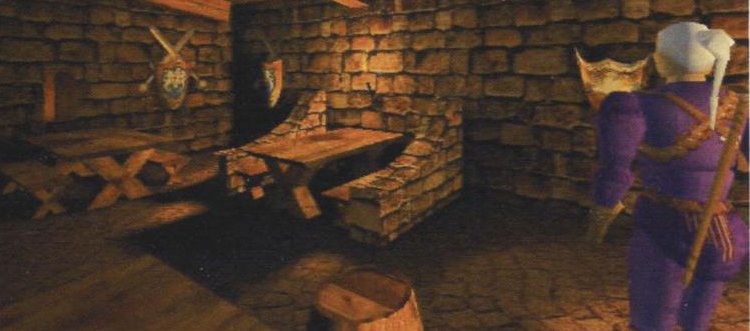
The Witcher is a book series by Polish author Andrzej Sapkowski. In 1997, a video game based on these books was in development for PC by Polish team, Metropolis Software, but this version of the game was never released for reasons unknown. In 2008, Metropolis were acquired by CD Projekt, a Polish company that in 2007 published the acclaimed The Witcher action RPG, which later became one of the most popular and successful RPG series in Europe and North America.
The Witcher 1997 by Metropolis Software was a completely different game from The 2007 Witcher project by CD Projekt RED. It was merely a coincidence that CD Projekt happened to purchase a studio that was working on a cancelled game of the same name. The Witcher 1997 would have been an ambitious action RPG with a big 3D world to explore filled with quests to complete and branching paths based upon decisions made during the story; aspects that also featured in the 2007 game.
We can speculate that Metropolis could possibly have encountered some issues in realising a large scale 3D open world RPG of this nature, as all their other games released from 1992 to 1998 were in 2D. It’s also possible that they simply were unable to find the backing of a publisher.
In 2009, CD Projekt closed Metropolis Software whilst they were working on a new FPS titled “They“.
An article about The Witcher by Metropolis Software was published in EDGE magazine issue #50.
Thanks to Celine and Roninakuma for the contribution!
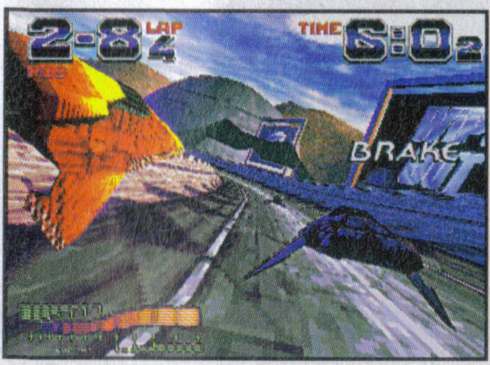
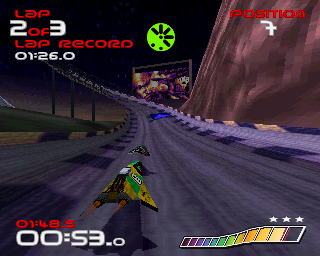
Wipeout is the first in a series of futuristic racing games developed and published by Psygnosis in 1995 for Sony PlayStation and PC, in 1996 for the Sega Saturn. Wipeout was designed in part by The Designers Republic, while the game’s vehicle designs were based on Matrix Marauders, a 3D grid-based strategy game whose concept was developed by Psygnosis employee Jim Bowers. Nick Burcombe, the game’s future designer, was inspired to create a racing game using the same types of vehicles from his experience with Powerdrome, F-Zero and Super Mario Kart. [Info from Wikipedia]
In the gallery below you can see a couple fo screens from a beta version and what is seems a FMV / target render.
As for the “Inspiration” the original game was very much “Mario Kart” to techno music. Nick Burcombe and Jim Bowers had designed the game from those beginnings; and an early concept video was made.
Wipeout Target Render / Concept Video:
Thanks to Rod_Wod and Celine for the scans! Thanks to Ross Sillifant for the interview!
This website uses cookies to improve your experience, by continuing to browse the site you are agreeing to the use of cookies. Find out more about cookies.Hide
Privacy & Cookies Policy
Privacy Overview
This website uses cookies to improve your experience while you navigate through the website. Out of these, the cookies that are categorized as necessary are stored on your browser as they are essential for the working of basic functionalities of the website. We also use third-party cookies that help us analyze and understand how you use this website. These cookies will be stored in your browser only with your consent. You also have the option to opt-out of these cookies. But opting out of some of these cookies may affect your browsing experience.
Necessary cookies are absolutely essential for the website to function properly. This category only includes cookies that ensures basic functionalities and security features of the website. These cookies do not store any personal information.
Any cookies that may not be particularly necessary for the website to function and is used specifically to collect user personal data via analytics, ads, other embedded contents are termed as non-necessary cookies. It is mandatory to procure user consent prior to running these cookies on your website.

![The Witcher (1997 version) [PC – Cancelled]](https://www.unseen64.net/wp-content/uploads/2010/09/the-witcher-cancelled-670x300.jpg "The Witcher (1997 version) [PC – Cancelled]")