Flying Nightmares 2 is a cancelled flight simulator / shooter that was in development for PC by Eidos Interactive, with a presumed port for the original Playstation and Saturn. As we can read in an interview by Combat Sim with Bryan Walker, Lead Producer of the FN2 project, the game was “a sequel to AV8B Harrier Assault, a game that Domark and Simis developed several years ago, and went on to become SVGA Harrier, the first 640×480 flight sim on the PC, and Flying Nightmares on the Macintosh“.
An online multiplayer mode up to 16 players was also planned. It seems that Eidos decided to shut down Flying Nightmares 2’s development team for unknown reasons and the game vanished with them. Only a self-running PC tech demo was released before the cancellation.
There is not much info on the presumed Playstation and Saturn ports, but Celine was able to find a scan with a short article about them on CD Consoles issue #4. We can assume that the console ports would have been a downgraded version with a more arcade-ish gameplay and no online mode.
Check the FN2 preview at Combat Sim for more info!
Big Guns (Exodus) is a cancelled shooter / action game that was in development by Neversoft Entertainment in 1996 / 1997. They were able to create a good-looking playable tech demo for this project that was shown to Shiny Entertainment on June 1996 to demonstrate their 3D engine in hopes that Shiny would hire them to develop the MDK Playstation port.
As we can read at the Playstation Museum, a coop mode was also available:
Exodus features a fast and furious two player cooperative play. Two player mode does not suffer from any slowdown as a result of the superior 3D engine. What makes Exodus stand out is that both players can combine their mechs into one larger mech. In transformation mode, player one would control the bottom half of the mech including walking and firing at enemies while player two would control the upper half which allows for 360 degree swivel as well as firing upon enemies.
Shiny was impressed with their technology and Neversoft started to work on the MDK conversion (that used the Big Guns engine), while the Big Guns concept was sold to Sony Computer Entertainment America.
Big Gus was meant to be published by SCEA in 1998, but 1997 was a tumultuous year for Neversoft. The MDK conversion took far longer than expected, and Big Guns, renamed Exodus, went through numerous design changes at the behest of Sony. Somehow Exodus was changed from a mech shooter to an action adventure featuring a cat-girl (sadly, we don’t have any image from this version of the game). The project was doomed and it was eventually cancelled in November 1997.
Neversoft shrunk to just twelve employees. The company then spent the next few months shopping around their technology, meeting with numerous companies and looking for work.
In January 1998, just as Neversoft was about to run out of money, they had a fortunate meeting with Activision who were looking for someone to re-develop Apocalypse, a failed internal project featuring the voice of Bruce Willis. The technology developed for Big Guns turned out to be ideal for the project, Activision wase impressed and Neversoft began work on Apocalypse.
In the end Big Guns / Exodus was never released, but at least its 3D engine was used for 2 other games: MDK and Apocalypse.
The Fallen is a cancelled action adventure game that was in development in 1995 / 1996 by Sensory Deception and it would have been published by Psygnosis for the original Playstation and PC. Sadly just few screenshots were found by Celine in CD Consoles magazine issue #19 and Edge magazine issue #33.
Below you can read the story / setting of the game, as announced at E3 1996:
The Lords are the law enforcers of the future, maintaining their own brand of vicious law and order in cities across the U.S. The Fallen are their prey, the drop-outs from society who fall foul of The System and want to find their own way without rules. When the two meet, only chaos can follow.
Play Lord or Fallen in this huge and minutely detailed strategic adventure which takes you from coast to coast across America and offers so many real-life options, you’ll think you’re there. And with bribery, corruption, gambling and violence all on the agenda, there might not be the place you want to be.
Some of the promised features:
Unique characterisation system introduces realistic characters capable of complex interaction.
Fully textured real-time 3D graphics.
Non-linear structure allows the player to dictate the action strategy.
Huge array of fully interactive vehicles, weapons and special objects.
Combat includes hand-to-hand fighting, vehicle ramming and use of futuristic weapons.
Multi-player options (PC version)
Even if we don’t know much about the project, from this description it seems that the gameplay could have been somehow similar to a futuristic Grand Theft Auto. The Fallen was cancelled for unknown reasons, maybe because it was too ambitious for 1996.
If you know someone who worked on this game and can share some more info or media, please let us know!
Thanks to Celine for the contribution! Thanks to Jason for the english corrections!
Sorcery is a cancelled fighting game that was in development for the original Playstation in 1997 / 1998 by Sony Interactive Studios America, later renamed to 989 Studios (Sony’s San Diego team). Players would have been able to choose between many fantasy characters that used fighting moves and spells to battle their opponents.
The first concept of Sorcery was much different from the playable prototype, as originally 989 Studios wanted to develop an ambitious multiplayer RPG, with a big overworld, quests and huge cast of characters. Because of the limitations of the PSX hardware and for economic reasons, Sony ordered the team to scale down the project to an arena fighting game (which was seen as more profitable / less risky).
As their own project was killed and because 989 Studios had no experience with fighting games, Sorcery went through various development issues that lead to its final cancellation after 2 years of work.
The original concept would have worked great in today’s on-line environment. The scope, which started out as a split screen, was to run around a large world, setting magical traps, using magic to detect and find your opponent, then finally tracking him down and combating him, kept getting whittled down further and further until it devolved into a magical arena fighting game, where opponents would stand across from each other in very small (fits on a single screen) arenas and dispatch each other with spells and counter spells.
Thanks to Stone and baphomet for the contributions! Thanks to Jason for the english corrections!
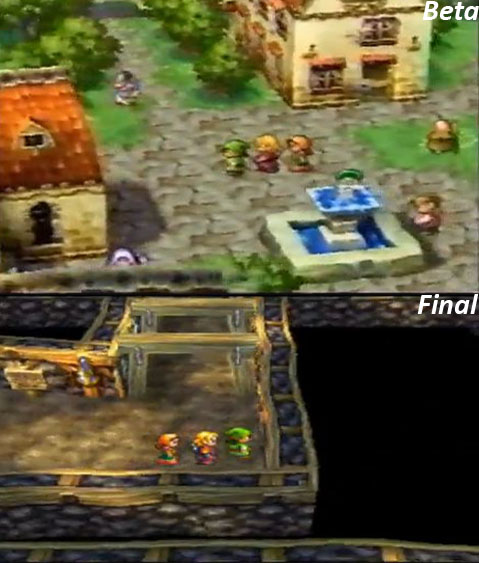
Dragon Quest VII (Dragon Warrior 7 in USA) was originally announced for the 64DD in 1996, but one year later the development switched to Playstation and the game was finally released in 2000. Unfortunately, we don’t know much about the beta versions of DQ7, but thanks to a video from the V Jump festival in 1998 (check below), uploaded by Carnivol in his YT Channel, we can see that originally Keifer (the blonde character) had a different dress.
Also, in the V Jump 1999 Festival video the monsters (especially their animations), seem to look better than their counterparts in the final version. What do you think?
Videos:
Compare the beta battles to the final ones (video below @ 3:36)
This website uses cookies to improve your experience, by continuing to browse the site you are agreeing to the use of cookies. Find out more about cookies.Hide
Privacy & Cookies Policy
Privacy Overview
This website uses cookies to improve your experience while you navigate through the website. Out of these, the cookies that are categorized as necessary are stored on your browser as they are essential for the working of basic functionalities of the website. We also use third-party cookies that help us analyze and understand how you use this website. These cookies will be stored in your browser only with your consent. You also have the option to opt-out of these cookies. But opting out of some of these cookies may affect your browsing experience.
Necessary cookies are absolutely essential for the website to function properly. This category only includes cookies that ensures basic functionalities and security features of the website. These cookies do not store any personal information.
Any cookies that may not be particularly necessary for the website to function and is used specifically to collect user personal data via analytics, ads, other embedded contents are termed as non-necessary cookies. It is mandatory to procure user consent prior to running these cookies on your website.