PC / MAC

Prax War 2018 [PC – Cancelled]

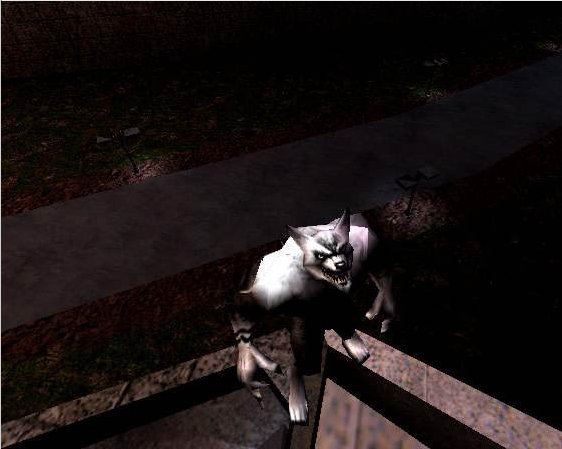
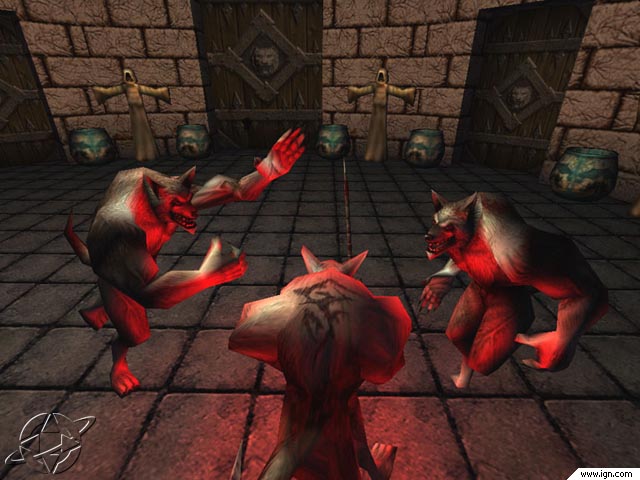
Prax War 2018 was an ambitious FPS that was in development in late ‘90s by Rebel Boat Rocker and would have been published by Electronic Arts, but it was cancelled in january 1999 when the publisher pulled the plug on the project because “things were not progressing as quickly as they would have liked”. The project was quite hyped at the time, because Rebel Boat Rocker was composed of former 3D Realms developers (such as Billy Zelsnack, Jason Zelsnack, Lee Kime, James Storey, Dirk A. Jones, Brian Martel, James Storey and Randy Pitchford), a team that previously created such classic FPS as Duke Nukem 3D, Shadow Warrior and Blood.

The game was being developed using a Java 3D engine, to permit a different number of polygons shown depending on the distance of the player from the enemies and enviroment:

“As players pull back from an adversary, the polygon count will go from a high of 1,000 up close to 150 at a distance. This will allow RBR to “bring back the mow-down,” according to Pitchford, where you’ll face a platoon of up to 50 soldiers at a time.”

Gameplay would have been somehow similar to Half Life, with players being sent to the field to take out a terrorist menace:

“The story for Prax War was this. In 2032 the megalomaniac known as Dante takes over Prax Industries using Nikki Praxus, recent inheritor of the company, as a pawn. He is now using the power source Praxium to create an army of mutants and you, along with your military squad known as the Eclipse Team, must stop him from causing global havoc.”

The story would have unfold through a quite open-ended series of areas to explore, with players being able to interact with the environment and vehicles, for example by stealing a mech from enemies to gain more firepower. Online multiplayer with classic modes such as Capture the Flag and Rocket Arena was planned too.

Prax War’s cancellation became quite infamous because it was announced through Randy Pitchford’s .plan file (a system used at the time to log a developer’s task list, notes and future plans):

“The word from EA that’s out there about why Prax War was cancelled just about sums it up. “EA’s reasons were that they missed their technology window on this product and that things were not progressing as quickly as they would have liked.”

I need to mention, however, that the RBR content team was working closely with the on-site EA director of development on tight content schedules and milestones right up to the end. This includes all game art, models, levels, animation, artist objects, sound effects, etc.

[…] I am truly sorry that the gaming public will never get to play Prax War, for it was truly becoming something remarkable.

It was with sad but optimistic fever I cleaned my office yesterday, I am proud of my work on Prax War and am rewarded by the respect it had received from those who had the almost unique pleasure of being exposed to what we were creating. It should’ve been revolutionary for single-player gaming.

But, alas, “our game is but a dream“.”

The last sentence from Randy’s .plan file is a reference to something wrote a few weeks before by Apogee / 3D Realm’s Scott Miller, still angry with Rebel Boat Rocker because they left 3D Realms. After the early rumors of Prax War’s cancellation, Miller celebrated / joked about it saying “Row, row, your boat, Our game is but a dream”.

Some more details about Prax War 2018 were shared by Pitchford in an article on Loonygames:

“Some interesting things were happening in the industry that influenced us two years ago when we were designing the game. The third person 3D game was evolving and it was exciting a lot of people. We had played Tomb Raider and Mario 64 and were taken by some aspects of what those games provided. I concluded that it wasn’t the third person perspective in itself that was so great. After all, we (like everyone else) had difficulty adjusting to the problems of the control interface for both Tomb Raider and Mario 64. It seemed to be consistent that every third person game was much more difficult to control than the first person games we were used to. However, the thing that was uniquely cool about the third person game was that you could witness your character up-close performing cool moves and displaying animations and behavior that were fun to watch. That perspective was impossible, by definition, in a first person game. Our solution was to add several characters that were partners with the player that could exist in the game with the player and give us all the cool advantages of a third person game without the disadvantages of an indirect interface. It just looked cool to see a guy back flip off a wall or something. Since you’d never see your own character perform the act (as your eyes are in his head), we used the other friendly characters to show off the cool animations. The key to this would be hundreds of custom scripted animations and some good friendly partner AI.”

“Prax War was becoming a first person shooter with a squad, but I wouldn’t call it a squad based game. “Squad based game” implies that the player must give commands to the other members of the squad. In Prax War, the friendly characters would act on their own. Our player wasn’t required to command the other teammates any more than Luke commanded Han Solo in the movie.”

“In addition to developing an amazing 3D rendering engine, the Zelsnacks were big fans of physics. The content developers had just come off working on Shadow Warrior, which was one of the first 3D shooters to feature vehicles that the player could jump in and out of. The game didn’t do vehicles realistically because of the limits of the sector based engine, but it was still fun. And, we were seeing how vehicle combat gaming with more realistic physics could make a really fun deathmatch in I-76. Our engineers were sure they could outdo the physics in I-76 (which they did) so vehicles became a big part of Prax War.”

“Finally, most of us knew that the future of the 3D shooter was going to finally have to take the player outdoors. Attempts at outdoor areas within engines designed for corridor shooters up that point had been not believable, at best. But, fortunately, the engine that was being constructed at RBR was based around the concept of arbitrary polygons. This would allow us to have small and detailed geometry for complex indoor environments and have huge polygons that could build a vast terrain mesh. We were going to be the first 3D shooter that did outdoor environments in the quality of a racing game or military sim.”

“[…] another game appeared that made extensive use of scripted animations and presented friendly characters. Half-Life turned out to be a huge success which begged questions from our publisher about whether or not we could compete. Considering that at the time of Half-Life’s release, we had tons of quality content and some great rendering features, but no actual game, I must assume that some worried that we could not.”

After Prax War 2018 was cancelled, Rebel Boat Rocker was closed down but a few members lead by  Randy Pitchford went on to fund Gearbox Software and created popular Half Life expansion packs Opposing Force and Blue Shift. In Half Life: Blue Shift, there’s an easter egg about Prax War: “In the laundromat, a scientist and a security guard are playing a fighting arcade video game, named Prax Wars 2: Dante’s Revenge; the security guard eventually loses the game.”

Images: 

Indiana Jones and the Fate of Atlantis [Beta – PC]

Disclaimer: This is mostly a backup of an old page created by ATMachine with details about the beta differences in the early versions of Indiana Jones and the Fate of Atlantis. It seems that the original page does not exist anymore, so we re-posted this to archive all the interesting details and changes. Enjoy!

The game was developed by LucasArts and released in 1992 as a sequel to “Indiana Jones and the Last Crusade: The Graphic Adventure”. Originally Fate of Atlantis was meant to be a tie-in to Indiana Jones and the Monkey King/Garden of Life, a rejected script written by Chris Columbus for the third, lost movie. In the end Hal Barwood and Noah Falstein wrote an original story and chosen the Atlantis setting for the project. Many beta screenshots were released in gaming magazines at the time and below you can see all the differences spotted by ATMachine

G.I. Ant (SegaSoft) [PC – Cancelled]

G.I. Ant is a cancelled real-time strategy game that was in development by SegaSoft / Sega Interactive for PC in late ‘90s. The project was inspired by classic RTS such as Warcraft II and Command & Conquer, with an original hand-to-hand combat following the team’s past experience with Eternal Champions, a 2D fighting game released for Genesis / Mega Drive in 1993. As you can assume by its title, the setting of the game was a war between ants and other insects, imagined with a World War II aesthetic, using rifles, jeeps and airplanes.

The G.I. Ant  team was composed of various Sega of America developers such as Hideki Ikeda, Charles Workman, Frank Lucero, John Kuwaye and Andrew Tjew; thanks to an interview by Sega-16 with Ikeda, we can read some details about the project:

Sega-16: The SegaSoft titles you were working on were canceled. What games were they and what were they about?

Hideki Ikeda: You might have a better interview talking to Frank Lucero about this one. The last one we (John Kuwaye, Andrew Tjew, and I) were working on was called Bug Wars which turned into G.I.Ant (as in “giant”). Bug Wars was John’s baby, but Frank incubated John’s idea and grew it into G.I.Ant, which was a cool concept of a game based on real-time strategy (back then, we were addicted to Command And Conquer and Warcraft II) and hand-to-hand combat (as in Eternal Champions-type fighting).”

In the end the project was never completed, probably because of low sales of all other SegaSoft PC titles.

Thanks to Rafael for the contribution!

Images:

Videos:
 

The Lord of the Creatures [Cancelled – PC, Xbox 360, PS3]

The Lord of the Creatures is a cancelled fantasy strategy / adventure game that was in development by Spanish studio Arvirago Entertainment (a team composed of former Pyro Studios devs, creators of the Commandos RTS series) for PC, Xbox 360 and PS3. The main feature of the game was to capture and use monsters in combat, somehow similar to a real-time Pokèmon action adventure mixed with Kameo, in a classic fantasy setting with orcs, elves and other strange creatures. The game was originally announced in 2003 but after a few years of development it was quietly canned and not much more info was ever released.

Players would be able to collect over one hundred different creatures, each one with exclusive abilities to use directly by impersonating one of them or by giving orders like in a real time strategy game. Enemies would attack in groups and we had to think about the best creatures for the fight, depending on their characteristics, weapons and items. Five different main characters were available, each one with a different play-style. Online cooperative and competitive modes were also planned, to test your tactical abilities and creatures along or against other players.

We don’t know what happened to Arvirago, but it seems that the studio does not exist anymore and they never released any game before to vanish forever.

Images:

Videos:


Kanaan (Argonaut) [PC – Cancelled]

Kanaan (Argonaut) [PC – Cancelled]

Kanaan (AKA Chaos when it was conceived on Playstation 1) is a cancelled first / third person open world shooter that was in development by Argonaut Games in late ‘90, planned to be published in 1998 / 1999 by Ubisoft on PC. While many other lost games from Argonaut were widely known, this one seems to have been forgotten for many years, until in January 2016 Werta Oldgamesru noticed this title and posted about it in our Unseen64 FB Forum. The project was quite an interesting twist on the classic shooter genre, because of its open world environments and anthropomorphic animal enemies. As noticed by Ross Sillifant, a two-pages preview of the game was featured in Edge magazine September 1998 issue, where we can read a lot of details about its gameplay:

“Think dark tunnels, think robot enemies, think bleak future worlds. The stereotype defined by ID’s seminal Doom has been adhered to with a near-religious reverence by developers worldwide. So perhaps, it’s salient that Argonaut, a traditional console game company once strongly linked to Nintendo, should be chipping away at the genre’s mould. Argonaut first person foray is currently dubbed Kanaan, although the search for a name to replace the development tag of “Chaos” has been a protracted wrangle. While the game’s futuristic setting is nothing new, its dog-themed alien enemies are refreshingly different. Guiding lone human Gabriel Cain, the player must stop the invaders from capturing his home planet of Camrose. Cain is one of two surviving members of Camrose’s crack Chaos Squad, the other being the group’s traitorous captain deSoto. As the game progress, new plot elements are introduced, including Cain joining the underground resistance. New weapons, locations and environments will gradually be uncovered as Cain struggles to defeat the alien foe. His eventual target is the alien leader Commander Kray, who must be brought down for Cain’s final victory.

Through the careful use of tessellation techniques, Kanaan has been gifted with vast environments. […] However, the game also contains a large number of structures which can be entered, the action blending smoothly from interior to exterior. Using Kanaan’s powerful 3D engine fully, certain buildings will feature balconies, giving the player the ability to look across an area and attack enemies from a distance.

In order to move swiftly around these incredibly open areas, the player can capture and utilize a variety of vehicles. These includes jeeps, cars, trucks, speedboats, helicopters and bombers, each with their own armoury available at Cain’s disposal. […]

While Kanaan’s standard viewpoint is first person, Argonaut has strong opinions regarding character depiction, and to that end an additional third person camera is selectable. […]

Cain also has access to a sniper weapon (as seen in Goldeneye) so he can pick-off foes from a great distance by zooming in through the weapon’s sights. Traditional first person puzzle elements also emerge, along with console systems which reveal conundrums that block progress.”

A few more memories about Kanaan’s development can be found in websites of people that worked on it. Simon Grell recalls:

“Kanaan was the first game I worked on at Argonaut. I did most of the character and vehicle designs but unfortunately it was canned shortly before it was due to be released”

In an interview with Julian Alden-Salter posted in the GameOn Forum, we can read:

“I spent 5 years at Argonaut working on Hot Ice (unpublished), Alien Odyssey (unpublished), Croc, FX Fighter Turbo and Kanaan but was made redundant when the project I was producing (Kanaan) was canned.”

As the game was almost complete when cancelled and even Edge was able to try a playable demo, we hope that in the future someone could find a video or even a prototype of Kanaan that could be saved.

Thanks to Werta Oldgamesru, Maik Thiele and Ross Sillifant for the contributions! Screenshots saved from AVOC by Fabio Cristi

Images:

Videos: