Few information is currently availableon that title. The game was initially revealed in June 2019 during an EA Play event as an “Action-RPG with Non-Playable Character Coop” where the player is a kid who build a giant robot sidekick to go on an adventure across a vibrant, alien multiverse. VG24/7 wrote:
At the top of a new video showcasing various small studios EA works with for its EA Originals program, was a striking image: a giant robot, and a kid climbing onto its shoulders. This, a gathering of press learns at a private EA Play 2019 event, is a brand new EA Original from developers Glowmade.
Rustheart is an action-RPG with NPC co-op. The robot is fully customizable, according to Glowmade CEO Jonny Hopper. Players will be able to build the robot so that it is unique and personal to them, from color to gear. The robot learns from the player’s actions too. Hopper cites the animated film The Iron Giant, the vibe of ’80s movies, and the comedy of Rick and Morty as key inspirations for Rustheart. “How do we make a game there,” he says was the big question around the studio with the cluster of inspirations, “what can we do with that?”
Previously, Glowmade collaborated with Tequila Works on WonderWorlds, a user-creation driven game. Rustheart is the studio’s first game under the EA partners banner.
However, after this announcement, RustHeart fell completely into obscurity and was never again officially mentioned in the press.
It wasn’t until April 2025 that a bit more information alongside a couple of screenshots were shared by Danny Whitehouse who was Senior Environment Artist on the project. According to his LinkedIn profile, he worked at Glowmade until October 2020 where he also worked on the game King of Meat, released 5 years later. To this day, it is still unclear why RustHeart was cancelled. The uncertainty surrounding the economy and the video game industry in the last few years might be a reason, but we can also speculate that something during the development didn’t come together, and the decision to shelve the project was made.
If you know someone who worked on RustHeart and could help us preserve more screenshots, footage or details, please let us know in this comment section!
With the release of the original Max Payne, many publishers were vying to release something just as good as Remedy Entertainment’s timeless action-noir experience. While you may not need more fingers to count how many Max Payne clones are out there (don’t worry, there aren’t many), you’d be surprised to find that some of these copycats were genuinely fun. For today’s occasion, we have El Matador, created by Plastic Reality Technologies and published by Cenega. The game has experienced various changes since its 2004 reveal, and it’s unclear why they were made. Luckily, you can see a bunch of pictures and videos showing the early look of the game for yourself:
Early Environments:
Early Main Character
Early Enemies
Observed Beta Differences:
Different enemies
The plot from the 2004 build is different to the final release
Different HUD (health, ammo, gun icons, and aim pointer)
Star Wars Outpost is a cancelled Real Time Strategy/simulation social network hybrid game developed from 2011 to 2012 by LucasArts Entertainment Singapore for browsers based PC and mobile devices. It was based on the eponymous movie franchise.
The existence of Star Wars Outpost was revealed after its cancellation alongside many others cancelled Star Wars related project during the closure of LucasArts, back in April 2013. At first, it was initially briefly mentionned by an article from Kotaku wrote by Jason Schreier back in September 2013, when we simply could read this:
The list of cancelled projects goes on and on. (…)
There was Outpost, the Star Wars take on Zynga’s FarmVille that would let players build empires, one click at a time.
It is only in January 2016, almost 3 years after the shutdown of LucasArts, that more details, alongside a couple of artworks, about the game emerged. Eurogamer was the first to relay those information:
A long time ago, before Disney‘s acquisition of Star Wars, LucasArts spent two years developing a “hardcore” strategy simulation for PC and mobile devices. And then it quietly cancelled the project, four weeks from completion.
This game was Star Wars Outpost, which was being built by a team of 30 working out of LucasArts’ Singapore office.
We were told Outpost was canned shortly before Disney’s acquisition – at which point other Star Wars games were halted, too. (…)
If you’re thinking you’ve heard Outpost’s name before, then you’re right – reports on the canning of 1313 and First Assault mentioned this third game, although at the time it was only referenced in the vaguest of terms – and described as a Farmville clone.
“The previous leaks mentioned a social game that was supposed to be Star Wars’ answer to Farmville,” the tipster said. “This is absolutely wrong.
“The people who thought [Outpost was a] Farmville game were from the US office. They had no idea about this game either – except just a few key people. This was being made 100 per cent in Singapore.”
At the time of its cancellation, Outpost was “about 90 per cent done”.
“We were just looking for approval to start public beta testing. Instead we got a call they were going to kill the project.”
Rather than a social game clone, Star Wars Outpost was designed to be a “very hardcore” experience. And despite the fact it might look like a game you’d find on Facebook, the title was canned because it was considered too niche.
“The best way to describe the game is if Star Wars met Settlers of Catan/EVE Online,” said the source. “You would take control of an Outpost on a planet within [the Star Wars galaxy]. The land on the planet was finite and so were the resources, so you were forced to search out and find other players. You had choices to either work with them or betray them for their resources.
“You could then start supplying weapons/ships/tools etc. to either the Rebels or the Empire. Supporting each side would control a balance of power where that side could start taking over the Galaxy.”
Nearby players who were allies would slowly become connected to you via networks of roads and trade routes. A world completely controlled by the Rebels or Empire would grant bonuses to the appropriately-aligned Outposts on it.
“It was a very deep game and always running like an MMO, we wanted players to really invest a lot in time,” the source continued.
Outpost also had a working day/night cycle, and an overworld populated by characters who would wander around and interact with the settlements and other characters in it.
But despite its hardcore aspirations, LucasArts was building the game to be as accessible as possible – coded in HTML5 and playable via a browser.
“We did it in 3D but everything was hand painted by artists to make sure we had a nice art style.”
There were deeper plans for Outpost, too. The game’s original design was for it to connect with Star Wars: First Assault, and allow you to create weapons or ships for use in the shooter.
“We had the back-end working but not in-game,” said the source. “Then the players from First Assault could buy those unique weapons and equipment. You could also send in dropship supplies to help a side during the fight.”
All of which makes it more of a shame we’ll never see Outpost. After the game’s cancellation its team was moved on to casual mobile games (“which all got killed also right at the Disney purchase”) while a few were shuffled onto the similarly-defunct Star Wars 1313. After two years of work, Outpost was dead.
In May of the same year, a short trailer showcasing some gameplay leaked onto the internet. According to the main source, the video was part of larger vertical slice demo that’s yet to be found:
When LucasArts still was a company not acquired by Disney, a real time strategy (RTS) Star Wars game was about to be released on PC and mobile devices.
(…)
Now, thanks to Elise Baldwin, who was the Audio Director on Star Wars Outpost, we are able to see a slice demo illustrating the combat mode of the game:
I was the Audio Director on this unannounced title which did not make it to marketplace. It was in development for over a year, during which time it went through three platform/engine pivots. It featured a simulation mode and a tactical combat mode. This video was part of a vertical slice demo illustrating the combat mode.
The death of LucasArts was truly a tragedy for many people, starting with the numerous employees worldwide who were laid off, and many projects, whether or not based on Star Wars, were cancelled both before and during the acquisition by Disney. In addition to Star Wars Outpost, and Star Wars 1313 and First Assault already mentionned above, we can add:
a 2D physics-based shooter called Caveland that was meant to be an experimental digital title
Smuggler, a game designed for cross-platform multiplayer that would let you play as a customizable character within the Star Wars universe, smuggling and trading between Facebook, tablets, and consoles
An iOS game called Death Star in which you’d get to control your very own version of the Empire’s space station
A Wii U project code-named Wingman that was modeled after the TIE Fighter and X-Wing games. This project would later evolved as Star Wars: First Assault “Version Two” which featured prototypes and elements that didn’t go to the “Version One”.
A Star Wars take on Grand Theft Auto that was based on a cancelled live action TV show named Star Wars: Underworld. The project would later change direction and evolved as a co-op shooter game similar to Gears of War, that would eventually lead to the first design of Star Wars 1313.
In the recent years, a tech demo of First Assault, alongside the complete Nintendo Wii version of Star Wars: Battlefront 3 leaked online. We can hope that, some day, others cancelled projects may be made available online to allow players to test them or learn more about them.
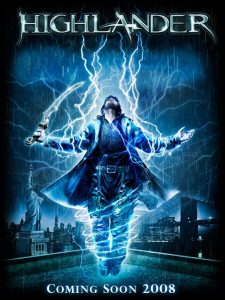
Highlander is a canceled action-adventure game published by Eidos Interactive and developed by Widescreen Games, for the PC, Playstation 3 and Xbox 360, from 2006 to 2008, based on the eponymous film franchise.
Initially, the attempt to develop a new Highlander game dated back well before this one. In September 2004, the company SCi Games managed to conclude an agreement with Davis-Panzer Productions, holder of the rights of the franchise. It was then Climax Studios which was responsible for developing a prototype for the Playstation 2. However, after the takeover of SCi by Eidos Interactive in May 2005, the project was, according to former Senior ProgrammerMarc Fascia, given to Widescreen Games before being put on-hold in August of the same year. The development was relaunched around the end of 2006, aiming for next generation’s hardwares, and officially announced in August 2007 during the Game Convention, although already in February of the same year, the preparation of a new Highlander game was leaked. During its official revelation, several details were disclosed:
“It will be a third-person action adventure that spans over 2000 years, giving you a chance to explore feudal Japan, medieval Scotland, a futuristic vision of New York and Pompeii before the historical volcanic eruption.
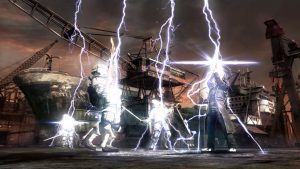
Similarly to the film, the aim will be to journey around the world and meet other immortal warriors in battle, lopping off their heads to win. You’ll have the choice of Katana, Claymore or Double to use, and be able to use various techniques to overpower your foe – like Resurrection, Chi Balance, Fireblade, Wind Fury, Stone Armour and other powered-up special attacks.
You’ll be the newcommer Owen Macleod, but come face to face with 77 other characters along the way – some familiar from the television series or films.
Widescreen is promising around 18 missions to tackle in general, and lots of ways to get around your environment: zip wires, dagger and traverse climbing, swan dives, free falls, cannonballs and beams.”
More information were shared in January 2008 alongside what was, for a long time, the only official video of the game:
“Publisher Eidos has officially announced that it will be bringing an Unreal Engine 3 game based on the popular movie and TV series Highlander to Xbox 360, PlayStation 3, and PC later this year. Eidos notes that the title, to be developed by Widescreen Games, will be written by TV series writer David Abramowitz, and will take series star Owen MacLeod “on a journey across multiple lands from first century fiery Pompeii, to futuristic New York to discover his destiny and explore the powers of immortality.” By nature of that immortality, Eidos says players will be able to exploit the unique powers it brings and “manipulate situations that death would normally prevent” such as channeling electricity and fire, impaling himself on enemy weapons to disarm them and falling from buildings to escape. The game will also feature “an advanced combat system, gamers will master a variety of Highlander swords including the Claymore, Katana, and Twin Gladius” which will “combine exciting swordplay with the Quickening powers of an Immortal.” MacLeod’s knowledge and strength will be enhanced with each other Immortal he beheads throughout the game.”
In March of the same year, it was an interview with ProducerGilles Baril, which explained in detail new points about the game, including its story, that appeared online:
Could you please reveal the beginning of the game’s plot, just a glimpse of the story?
G.B.: “The game starts in New York – large parts of the city are being evacuated but nobody knows why. The hero, Owen McLeod, is about to leave the city when several heavily armed men burst into his loft apartment. As the story unfolds, Owen finds out that a powerful immortal is the leader behind the attacks, searching for a mysterious artefact which was broken many years before into three fragments. Owen sets off after the fragments, sensing that his destiny is closely linked to this ancient artefact, he racks his memories for clues, memories which will plunge him into three different key periods of his past.”
Can you describe the different environments on the game and where it all takes place historically?
G.B.: “The game takes place in modern day New York where Owen must sift through his memories in order to unfold the story. These memory flashbacks take place in: Pompeii in the 1st Century AD, where, as a young gladiator, Owen meets his mentor who teaches him of his true nature and of the rules to the Game; The Highlands in the 9th Century where, in search of his origins, he befriends a fellow Immortal named Ryan, with whom he fights side by side against the Viking ravagers allied to the powerful Pict sorcerer Barak; and finally, Japan in the 14th Century, where, with his ally Methos, he protects the sanctuary of Kusanagi-no-tsurugi, a legendary blade, and fights Shinu, Lord of the Tengus, who seeks to make off with this sacred artefact.”
In the game will you leap between different time periods in history? Will the game also include an RPG element as you progress?
G.B.: “The game moves between New York to Owen’s memories in past time periods so you’ll be moving between different time periods as Owen tries to discover the key to what is happening to him in New York. We’ve kept to a good balance of navigation, combat and story. Each environment varies in terms of balance of these three elements. This is a tricky balance to get right but we’re happy with the outcome. There will also be an element of RPG to the game as you will be able to upgrade Owen’s combat and Quickening techniques as you play through the game, depending on the choices you make as you play.”
Can you explain how you will be able to upgrade your character?
G.B.: “The player can upgrade their player character, weapons and immortal Quickening techniques in two ways – by spending experience points earned in the game and by finding secret bonuses hidden in the levels. The player can earn extra experience points by using more skilled combat moves to finish off their opponents and by completing secondary objectives in the levels (for example, saving all the innocent Scottish villagers from being slaughtered by the Vikings in the Highlands). Upgrades enhance the strength of the weapons, the power and scope of the Quickening effects and increase the abilities of the player character.”
We understand that you can move both on rooftops and on the ground in the New York part of the game. Can you explain how this happens?
G.B.: “The game features levels where navigating deadly heights is crucial. One of these levels features a wind effect which will blow the character off unless the player is careful. The New York levels are pretty vast and do feature gameplay on the ground and higher levels/roofs, however we also have to take care to ensure the player doesn’t get lost, so there are some limits.”
How does the combat system work?
G.B.: “Each weapon has its own set of attacks and the player can create their own combos. This evolves further when Owen is in Fury mode which gives him much stronger attacks. Using the Weapon Mastery Quickening technique each weapon can also become even more destructive. We’re very confident that the combat experience will be easy for players to pick up and play and will also provide a real unique Highlander flavor.”
Will you fight other Immortals?
G.B.: “There are boss fights with other Immortals but we wanted to keep the Immortal fights special so in many parts of the game Owen will be fighting mortals. Some of the mortals are aware that Owen is an Immortal and have been hired to kill him, like the men invading his apartment in New York at the start of the game, whereas others are just generally up to no good like the Vikings invading the Scottish highlands in later levels.”
However, the game, initially planned for the summer of 2008, disappeared again from the radar and was no longer mentioned. We can see that several Widescreen employeesstoppedworking on it around the time when it was supposed to be released. In February 2009, following the economic crisis, Eidos was bought by Square Enix to become Square Enix Europe. In April of the same year, some sources declared that David Abramowitz, during a convention dedicated to Highlander told that the game was postponed indefinitely following disagreements between Eidos and Davis-Panzer. In parallel, Widescreen was already working on a new project, The Witcher: Rise of the White Wolf, before filing for bankruptcy in July 2009. Oddly enough, it was not until December 2010 that Square Enix confirmed the cancellation of the game, which could imply that after the shutdown of Widescreen, the publisher planned to relaunch the development of the game with a new developer.
It was never officially revealed why Highlander was canceled. In this comment section, an anonymous source claiming to have worked on the game indicate that it was finished but was of poor quality and would justify the delay announced by Abramowitz in April 2009, but this remains to this day only pure speculation. On the other hand, Alexis Madinier, one of the former developer on the game wrote on his LinkedIn profile that it was:
“canceled due to clash between publisher and IP Owner. At 2 months of the release…“
Which could confirm the words of David Abramowitz during the convention. No further attempts to develop a new game based on the Highlander franchise have materialized after that one for now.
In March 2026, a complete, although unfinished and buggy, playable prototype dated from April 2008, leaked onto the internet and made available on Hidden Palace.
Special thanks to Wavy Mavis for providing all soundtracks initially composed by Richard Jacques for the game!
Images:
Videos:
Official Highlander’ soundtrack by Richard Jacques. Thanks to Wavy Mavis and the timestamps, we can learn a bit more about the game.
Unsurprisingly, with so much quality for its time, beside being a critical success and earning numerous awards, F.E.A.R. was also a commercial success selling over two million units worldwide, across the PC, PS3 and Xbox 360. It should therefore come as no surprise that a sequel was quickly put into development. This is where things get complicated. Officially revealed in May 2004 by Monolith, the first F.E.A.R., as mentioned above, was published by Vivendi whose contracts had already been signed. But in August of the same year, it was another publisher, Warner Bros. Games, which acquired Monolith. This will create for a few years a split regarding the ownership of the rights of the F.E.A.R. franchise. In broad terms, and as explained by 1UP back in 2007, Monolith and Warner owned the rights to the F.E.A.R. intellectual property and characters, and Vivendi owned the name “F.E.A.R.” As a result, any non-Vivendi game set in the F.E.A.R. universe could use the characters and events from the original game, but could not be called F.E.A.R. At the same time, any non-Warner game set in the F.E.A.R. universe could not use the characters and events from the original game, but could be called F.E.A.R.
In February 2006, Monolith began to work on a sequel of F.E.A.R. simply named Project Origin, in reference to a key plot element from the first game. It was not until September 2008, after 2 and a half years of development, that Vivendi made the decision to give back the F.E.A.R. brand to Warner. Subsequently, Project Origin was renamed F.E.A.R. 2: Project Origin, as stated by IGN:
It’s a bit funny how the corporate world works. In 2005, Sierra and Monolith put out an acclaimed first-person shooter called F.E.A.R. that blended elements of Japanese-style horror with kinetic gunplay. But prior to that, in 2004, Monolith was acquired by Warner Bros. Interactive Entertainment, which meant that things would get complicated for any follow-up. Sierra owned the name F.E.A.R., but Monolith was the company responsible for actually making it. So what happened next was a bit comical. Warner Bros. Interactive Entertainment announced Project Origin, a game that would effectively be the spiritual successor to F.E.A.R., while Sierra would make F.E.A.R. 2 with another developer.
And then came 2008. Vivendi Universal Games, the parent organization of Sierra, merged with Activision to become the largest third-party publisher in the world. VUG’s crown jewel, of course, is Blizzard, the studio responsible for World of Warcraft, StarCraft II, and Diablo. Sierra’s lineup was examined, and most of its games were recently dropped. Indeed, Sierra’s future is in doubt.
Senseing an opportunity, Warner Bros. and Monolith struck, and they are announcing today that they have acquired the F.E.A.R. name, meaning that the creator of F.E.A.R. once again has access to the name. To that effect, Project Origin is being renamed to F.E.A.R. 2: Project Origin.
While a F.E.A.R. 2 was officially in development for Vivendi, it was, for many years, totally unknown what could it be and which company had the task to make the game.
It wasn’t until October 7th, 2021 that YouTuber Dead Domain uncovered and shared information about that F.E.A.R. 2. Through investigative work regarding initially a documentary about the troubled development of F.3.A.R., they were able to get in touch with Art DirectorHeinz Schuller and Narrative DesignerCory Lanham, both working at Day 1 Studios, the company chosen by Warner for the making of F.3.A.R., the final official game in the main series. Today, thanks to them, Unseen64 has the authorization to share the information collected by them regarding this F.E.A.R. 2 by Day 1, revealed in the documentary F.E.A.R. 3: Aftermath. We thank them very much and, mainly, keep in mind that all the credit goes to them.
The Day 1 game began its development somewhere between the end of Winter and the beginning of Spring 2007, was loosely inspired by the Philadelphia Experiment, and was to depict a new phasing technology falling into the wrong hands and being used to open up a passage to and from asupernatural parallel universe called the World Behind the Walls. To close it, a F.E.A.R. squad is deployed. The concept arts showing characters, enemies and environments that you could see in the video, alongside our gallery below were mainly the work of Character & Concept ArtistGrant Hillier. As Dead Domain pointed out on the environments of the World Behind the Walls:
The concepts for the World Behind the Walls show skeletal otherwordly structures and unreal geometry. There are even some that feature what appear to be ambient wildlife.
Another interesting piece of trivia about this F.E.A.R. 2 concerns the Phase Soldier, an enemy that would be able to shift between realities. The original concepts depict them as members of the US Navy, we could make an assumption that it was to emphasize the inspiration taken from the Philadelphia Experiment.
When the F.E.A.R. name was re-acquired by Monolith and Warner back in September 2008, the work done by Day 1 for F.E.A.R. 2 was cancelled by Warner as, mentionned above, Project Origin became the official sequel to the first F.E.A.R. They decided nevertheless to give the development of a third F.E.A.R. game to Day 1. Heinz Schuller explained:
(…) because of that, they decided ‘okay, we’re going to make Project Origin F.E.A.R. 2, and we’re going to make the game that you guys working on will become F.E.A.R. 3’. What our F.E.A.R. 3 started out as evolved quite a bit from when we started it until we ended it. Suddenly we had all the F.E.A.R. universe back: we could use all the characters from F.E.A.R. and F.E.A.R. 2.: Project Origin. So that was pretty much a total reboot of the narrative of our game. All of our sort of Phase Soldiers and sort of parallel universe stuff went away.
Still according to Heinz Schuller, the Phase Soldier is the only surviving element of their F.E.A.R. 2 that was transferred to the final version of F.3.A.R., although totally redesigned:
We did take along this idea of phasing and technology that would allow soldiers to essentially beam in and out of our world. So one of the enemies in F.3.A.R. is this heavy Phase Soldier. He can zap into a scene and create an energy field and spawn soldiers around him. I think that was the only element that really survived from our F.E.A.R. 2.
The rest of this documentary focuses on the entire development of F.3.A.R., based on various testimonials from former Day 1 developers. It is worth mentioning that the game still had some changes. Thus, we can learn that some levels never got past the concept art stage such as an underground level with the streets above viewable through holes in the ceilings, with hallways showing the Old City set up with mannequins for tourist attraction, or a ferry ride serving as the penultimate level of the campaign where the two protagonists were transported to the island where the Project Origin’s laboratory is located. According to the art style guide, this level should have been more oriented towards exploration and horror than action, with Point Man who would have been in spectral form just like Paxton Fettel. We can also add that the latter went through various design for his appearance, which was, in the beginning, more focused on a ghoulish aspect:
The narration was also modified on certain points, such as for example the opening sequence which, according to Cory Lanham, was to take place in the middle of the game, in what is the equivalent of Interval 05 – Tower in the final title, before returning the player back during subsequent missions to explain why we find ourselves in this situation. A narrative process called In Media Res, notably used in God of War: Ascension:
(…) I had written and pitched a whole idea for the opening of the game, I think it was originally supposed to open like somewhere towards the latter part of the game, it’s like a preview of what’s coming and then we take you and put you back 12 hours earlier or whatever. So I had written this whole sequence that bounced back and forth between that sort of high action huge moment like the one around the space needle, where it was supposed to open originally, and then it sort of goes back to the Favela at the beginning. It would go back and forth between a cinematic of Alma giving birth to the two brothers, and then cut, and then just keep coming back to the gameplay of lots of high action. And then, the whole idea was to carry the sound effect of the EKG through the transition between the cinematic with the giving birth stuff and the high action stuff, there would be always that sound effect in the background that sort of would be tied in. But it was too expensive basically. That was what it boiled down to, and I think also the guys from Monolith really had a vision that they wanted to execute on, so it really didn’t fit in what they were thinking about doing so.
Another idea that didn’t make the final cut was also to base the entire campaign in South America, especially in the favelas, but as Warner became more and more implicated in the development of F.3.A.R., that idea was dropped in favor of locations inspired by cities from the Washington state, such as Seattle. Heinz Schuller recollected:
Originally, we wanted to base the whole narrative in South America. At the end of F.E.A.R. the idea was Point Man went and holed up in South America for the entire duration of F.E.A.R. 2: Project Origin. (…) We thought we were all really smart by coming up with this really cool original premise, and then Modern Warfare 2 came out and was based in favelas and then the Hulk movie came out which was also based there. But then, Warner had started to get, with T.J. Wagner, working out the locations and they wanted to move the game narrative up to Pacific Northwest, in a post-apocalyptic version of Seattle, where the original nuke went off at the end of F.E.A.R. We fought a lot of battles to try to keep as much of the favelas stuff in, but it ended up just being the first level of the game, so if you remember, you spawn in a prison in South America and you have to break your way out. Even though a lot of that was reworked, that was kind of still the anchor to our first draft of F.3.A.R.
As we can read on the old blog of Art ManagerStephen Langmead, it seems the art direction made by Day 1 was also reworked, this time by Exis Interactive:
(…) We weren’t happy with the quality so we were having them redone by our outsourcer Exis Interactive, who we incredible to work with.
In the screenshots in the last gallery below, we can see some redesigns here and there such as the HUD, the weapons or the airport level which would have made us move in a plane full of dead bodies and potentially what could be appears as an NPC.
F.3.A.R. was finally released in June 2011 after being delayed numerous times and received “mixed or average” reviews from the press. It seems the game’s sales were disappointing, and the F.E.A.R. franchise has been on hiatus since then.
Although considered as the black sheep of the franchise today, it is difficult not to feel a certain sympathy for the developers at Day 1 Studios who had to endure years of reboots in addition to crunches and burnouts. We may not like F.3.A.R. for what it is, but we can’t really blame the members of Day 1 who tried their best despite numerous setbacks hence the final result.
From then on,Unseen64 would like to thank through this article Heinz Schuller, Cory Lanham, Stephen Dinehart, Matt Mason, Chris Julian, Greg Ruddick, Matthew Singer as well as all the other members of Day 1 who were directly or indirectly involved in the development of F.3.A.R., and above all, a very special thanks to Dead Domain for having kindly accepted that we could transcribe certain parts of their documentary for this article.
Day 1’s F.E.A.R. 2 images:
F.3.A.R. Concept arts from cut levels:
F.3.A.R. screenshots’ version by Day 1 Studios showing cut or modified levels:
Videos:
Gameplay prototype before the art reboot made by Exis Interactive. Both videos provided by Art DirectorHeinz Schuller.
This website uses cookies to improve your experience, by continuing to browse the site you are agreeing to the use of cookies. Find out more about cookies.Hide
Privacy & Cookies Policy
Privacy Overview
This website uses cookies to improve your experience while you navigate through the website. Out of these, the cookies that are categorized as necessary are stored on your browser as they are essential for the working of basic functionalities of the website. We also use third-party cookies that help us analyze and understand how you use this website. These cookies will be stored in your browser only with your consent. You also have the option to opt-out of these cookies. But opting out of some of these cookies may affect your browsing experience.
Necessary cookies are absolutely essential for the website to function properly. This category only includes cookies that ensures basic functionalities and security features of the website. These cookies do not store any personal information.
Any cookies that may not be particularly necessary for the website to function and is used specifically to collect user personal data via analytics, ads, other embedded contents are termed as non-necessary cookies. It is mandatory to procure user consent prior to running these cookies on your website.