
Final Fantasy 6/4?
[Warning: this article was originally written in italian many years ago, with the help of information from lots of websites, forums and people.. but we don’t know anymore the exact source of some of these info]
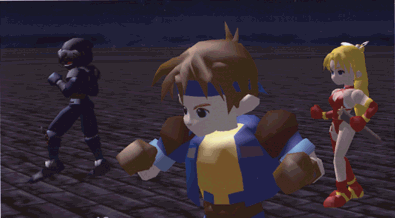
According to some magazines in 1995, a new chapter of the Final Fantasy series was already in development for the Nintendo 64 and there were even rumors of a simultaneous release in the U.S. and Japan for the end of 1996. Was it for real? Not really. In order to test the new Silicon Graphics hardware, Squaresoft created a now well-known interactive CGI demo (not running on the real Nintendo 64 hardware, even if the N64 was powered by Silicon Graphics) with characters from Final Fantasy VI, to show it at the SIGGRAPH 95 expo. That was the “Final Fantasy 64” that magazines talked about, but it was not really a game for any console, just a tech demo. The real Final Fantasy 7 would later be released in 1997 as a PlayStation exclusive. But what really happened between Nintendo and Squaresoft, and why was there no Final Fantasy for the N64?
[Original article in italian by monokoma, translation by Yota with the help of FullMetalMC and Nate Edwards]
The unpredictable events of the 32/64 bit console generations can be traced back to a single announcement already known in the industry in the autumn of 1995, even if the official confirmation came only the next year. Squaresoft, a software house at the time believed to be inseparable from Nintendo, announced that the seventh chapter of the Final Fantasy RPG series would only be released for the Sony PlayStation.
Because no official reason for this surprising decision was ever offered to the public, it was simply assumed that the main cause for Square’s switch was Nintendo’s decision to use cartridges for their new console instead of the more capacious CDs. Certainly this ill-fated choice was one of the most important reasons, but, as we will see in this article, not the only one.
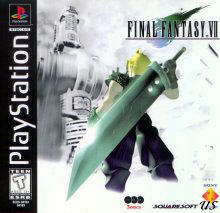
Nintendo, until 1996, owned a certain percentage of Squaresoft shares and thus had some influence in Square’s marketing decisions. However, Nintendo sold those shares and they were bought by Sony. Square made an agreement with the new partner: all the expenses for the production and the initial release of Final Fantasy VII would be covered by Sony. But in order to really understand this deal, we need to go back a few years, to when the misunderstandings between Nintendo and Square really began.
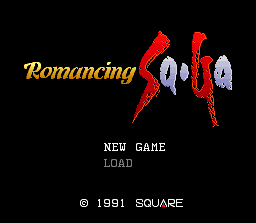
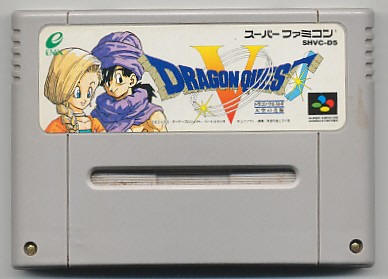
Romancing Saga, a new RPG in development at Squaresoft that was supposed to debut on the Japanese market in the autumn of 1991, was delayed by more than two months due to numerous problems with the normal cartridges of the SNES. Squaresoft requested a permit to Nintendo to use carts bigger than 12 MB, in order to remove some bugs and limitations in the game. But plans of Nintendo were quite different, and the request was denied. Yet Nintendo allowed the use of new 16 MB carts only a few months later on Enix / Chunsoft’s new RPG, Dragon Quest V. For Square, there was no other choice than to release the game without certain features.
From Wikipedia we read that: “Nintendo announced that they were working with Sony to develop an add-on for the SNES. The SNES-CD was to be announced at the June 1991 Consumer Electronics Show (CES). However, when Hiroshi Yamauchi read the original 1988 contract between Sony and Nintendo, he realized that the earlier agreement essentially handed Sony complete control over any and all titles written on the SNES CD-ROM format. Yamauchi decided that the contract was totally unacceptable and he secretly canceled all plans for the joint Nintendo-Sony SNES CD attachment. Instead of announcing a partnership between Sony and Nintendo, at 9 a.m. the day of the CES, Nintendo chairman Howard Lincoln stepped onto the stage and revealed that Nintendo was now allied with Philips, and Nintendo was planning on abandoning all the previous work Nintendo and Sony had accomplished. Lincoln and Minoru Arakawa had, unbeknownst to Sony, flown to Philips headquarters in Europe and formed an alliance of a decidedly different nature – one that would give Nintendo total control over its licenses on Philips machines.
After the collapse of the joint project, Sony considered halting their research, but ultimately the company decided to use what they had developed so far and make it into a complete, stand-alone console. As a result, Nintendo filed a lawsuit claiming breach of contract and attempted, in the U.S. federal court, to obtain an injunction against the release of the PlayStation, on the grounds that Nintendo owned the name. The federal judge presiding over the case denied the injunction and, in October 1991, the first incarnation of the new Sony PlayStation was revealed. However, it is theorized that only 200 or so of these machines were ever produced.
By the end of 1992, Sony and Nintendo reached a deal whereby the “Sony Play Station” would still have a port for SNES games, but Nintendo would own the rights and receive the bulk of the profits from the games, and the SNES would continue to use the Sony-designed audio chip. However, Sony decided in early 1993 to begin reworking the “Play Station” concept to target a new generation of hardware and software. As part of this process the SNES cartridge port was dropped and the name of the console changed to “PlayStation” (without the spaces).
Squaresoft had already begun to work on a new title which would make full use of the SNES CD-ROM. That game was Seiken Densetsu 2 (Secret of Mana in the West), but after the cancellation of the CD add-on, development had to be scrapped and redone. The map was completely redesigned and nobody (apart from the programmers) will ever know what we lost of the original Seiken 2 project.
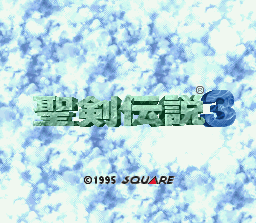
Autumn 1995: Square, due to productions problems, decided to release their next games with an initial print run of 700,000 instead of the usual 1,000,000. This choice of was not well greeted by Nintendo, who claimed this was a breach of contract.
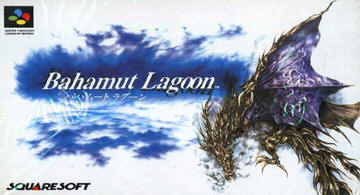
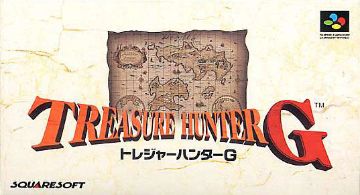
At this point, it was clear that the relationship between Nintendo and Squaresoft had become quite problematic. Super Mario RPG, the game that symbolized the companies’ partnership, never received a sequel. Then, against their normal marketing habits, Squaresoft released their last series of games for SNES (Bahamut Lagoon, Rudra’s Treasure, Gun Hazard and Treasure Hunter G) in just a few months.
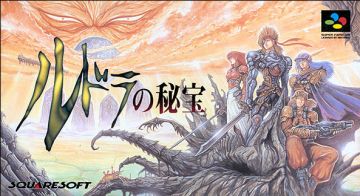
It was obvious that the ties between the two houses were no longer very tight. It is precisely in this complicated situation that Sony came on the scene. The creators of the Walkman offered an aggressively competitive price for developers to produce CD games for the PSX, unlike the expensive royalties Nintendo took from N64 game developers. Also, Sony decided to finance DigiCube, a Japanese company created in order to market and distribute Square games. Squaresoft certainly did not miss the opportunity. From this point onwards, the rest is history, and Square did not release a single Final Fantasy title for a Nintendo platform until 2002.
“I might be wrong”
These were not the only reasons for all the disagreements between Nintendo and Squaresoft, but they certainly had a heavy influence on the various decisions between the two software houses. As it often happens in the world of video games, we have more information from unofficial sources than from the official ones. The accuracy of many statements in this article thus cannot be proven, because too many years have passed since the events themselves to find the original news articles, forum posts or even to seek confirmation from those directly affected. Marketing decisions, especially in a field that involves huge amounts of money like video games, are not always easy to understand for us outsiders, yet it seems that we cannot go on without trying to discuss them.
[Original article in italian by monokoma, translation by Yota with the help of FullMetalMC and Nate Edwards]
Video article with updated details (Italian only for now, sorry!)
What do you think about this unseen game? Give your vote!

 (3 votes, average: 3.00 out of 5)
 Loading...
Would you like to add more info, screens or videos to this page? Add a comment below!

- Highlander [PC / PS3 / Xbox 360 – Cancelled] - 08-02-2025
- Aliens: Colonial Marines [PS2 – Cancelled] - 14-10-2023
- Outcast 2: The Lost Paradise [PC, PS2 – Cancelled] - 12-12-2022
who would have thought that it all began with Romancing Saga, and Square ending up being denied a 12 MB cartridge. However Enix’s Dragon Quest V was put on a 16 MB cart. Talk about unfairness Nintendo. It’s no wonder Squaresoft went to Sony for their games instead. N64 carts were limited to 64 Megabytes where as CD’s held 700 Megabytes a Disc; talk about a BIG difference that made for dev’s.
It all adds up why N64’s library was 330 titles released in the U.S. while Sony Playstation had over 7,000 titles released Worldwide. Sony dominated in every way back then. To think PS4 has become the new PS2.
indeed, Nintendo really destroied their relationship with Square in the late ’90… i’d love to update this article with more info and sources sometimes in the future…
For anyone who happens across this article: in 2017, Polygon published an extensive investigative report on the development of FFVII, going in-depth on the switch from Nintendo to Sony. It includes numerous interviews with people who were involved on all sides of development, publishing, marketing, and PR.
https://www.polygon.com/a/final-fantasy-7
Thank you Allen! I did read the Polygon article sometime ago, it’s really awesome, so much info! Maybe one day i’ll also update this old article, i recently created a video on this topic in Italian ( https://www.youtube.com/watch?v=mA1gmSN4ZlI ) so I could try to translate the script in english in the future :O