
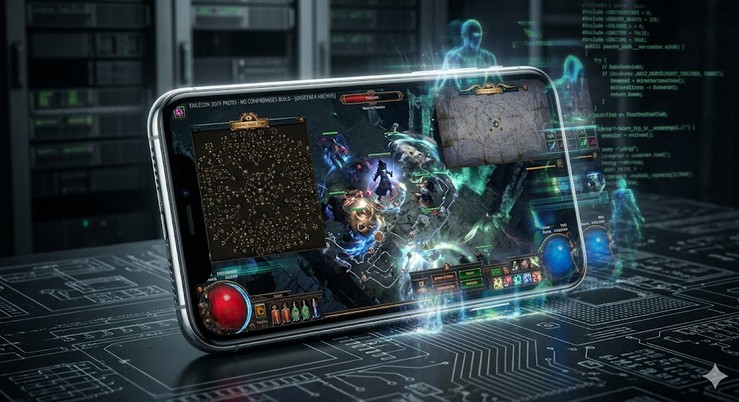
In the world of video game preservation, there is a special category reserved for the “perpetual beta”—titles that are publicly demonstrated, playable by attendees, and then vanish into a multi-year development cycle that fundamentally alters their DNA. One of the most fascinating examples in modern ARPG history is the 2019 “No Compromises” build of Path of Exile Mobile.
Announced during the height of the mobile gaming “dark patterns” controversy, this build was presented as a defiant rebuttal to the industry’s trend toward simplified, pay-to-win ports. Yet, as of April 2026, the original vision of that 2019 build remains a “ghost,” haunting the development logs of Grinding Gear Games (GGG) while the studio focuses on the massive rollout of Path of Exile 2.
The ExileCon 2019 Reveal: A Vow Against Mediocrity
The story began on November 15, 2019, at the inaugural ExileCon in Auckland, New Zealand. While the industry was still reeling from the “Do you guys not have phones?” backlash of rival titles, GGG co-founder Jonathan Rogers took the stage to announce Path of Exile Mobile.
The core of the presentation was a short, tongue-in-cheek video titled “Path of Exile Mobile Official Trailer” (Grinding Gear Games, Nov 15, 2019), which explicitly mocked “evil” mobile game tropes like energy bars, notification spam, and pay-to-win loot boxes. Rogers promised a “no compromises” experience—a complete port of the Path of Exile engine that didn’t sacrifice depth for accessibility.
“We wanted to see if we could get the real Path of Exile game running on a phone… it’s the full game, not a cut-down version,” Rogers stated during the ExileCon 2019 Keynote (Grinding Gear Games, Nov 15, 2019).
The Original Technical Vision: A Lost Prototype?
The 2019 build was unique because it was based entirely on the Path of Exile 1 ecosystem. Attendees who played the demo reported a UI that was remarkably faithful to the PC version, featuring the iconic sprawling passive skill tree and the complex socketing system. This was not a “Mobile Edition” developed by a third-party studio like NetEase; it was an in-house project using the same C++ codebase as the desktop client.
According to community-reported feedback from the ExileCon 2019 floor on the r/pathofexile subreddit (Nov 2019), the game ran at a surprisingly stable frame rate on contemporary iPhones, featuring the Atlas of Worlds and endgame maps—content usually reserved for high-end PC play.
However, this specific iteration of the game is now considered an “unseen” relic. Following the announcement of Path of Exile 2, GGG shifted much of the mobile development to align with the new game’s improved animations, lighting engine, and simplified (but deeper) gem system. The “No Compromises” build of 2019, which aimed to mirror the 2019 state of PoE 1, has effectively been overwritten by the modern standards of the sequel.

Economy and the “No Pay-to-Win” Ghost
One of the most ambitious claims of the 2019 build was its approach to the economy. GGG intended for the mobile version to share the same ethical monetization as the PC version. In a market where users often look for Path of Exile currency for sale to keep up with competitive leagues, the mobile version promised an ecosystem free from “stamina” or “autobattle” mechanics that usually force spending.
While the mobile market is notoriously difficult to monetize without “whaling” mechanics, Rogers maintained that the mobile economy would remain player-driven. Community discussions in The Destin Channel’s interview with Jonathan Rogers (Dec 4, 2025) suggest that the mobile version might eventually share a marketplace with the console or PC versions, though this remains an unverified “community-reported” theory.
As we move into the 0.5.0 era of the sequel, many players are keeping a close eye on the PoE 2 currency price across different platforms, wondering if the mobile release will finally bridge the gap between desktop complexity and on-the-go trading.
Why Has the Ghost Lingered?
The delay of Path of Exile Mobile—now spanning over six years since its first playable demo—is largely attributed to the scope creep of Path of Exile 2. What was once a “side project” intended to prove a point about mobile gaming has become a technical testbed for the studio’s cross-platform ambitions.
In a recent podcast, Talkative Tri’s Interview with Jonathan Rogers (Dec 8, 2025), it was revealed that the team is still iterating on the “feel” of touch controls for high-intensity endgame combat. The “No Compromises” vow has ironically become the project’s biggest hurdle; porting the sheer density of a Path of Exile map to a 6-inch screen without cluttering the UI is a design challenge that has outlasted two entire console generations.
The Legacy of the 2019 Build
For gaming historians at Unseen64, the 2019 build represents a pivot point. It was a moment where a major developer tried to force the mobile market to “grow up” by refusing to strip down their core product. Whether the eventual release of Path of Exile Mobile (expected to enter a wider beta alongside the PoE 2 1.0 launch) will retain the spirit of that 2019 “Ghost in the Machine” remains to be seen.
For now, the original 2019 build exists only in trailer archives and the memories of a few hundred ExileCon attendees—a “no compromises” phantom in an industry that almost always compromises.